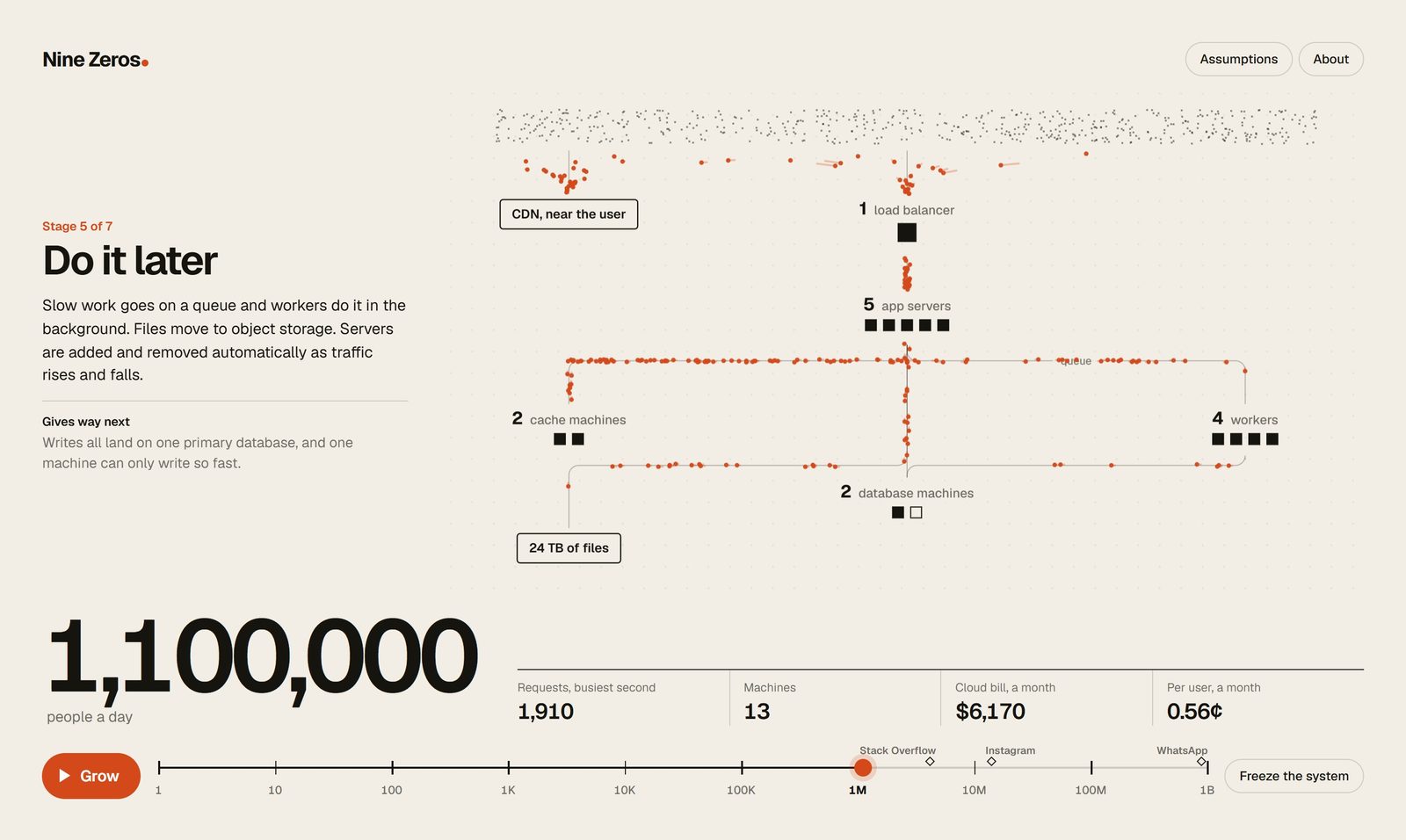
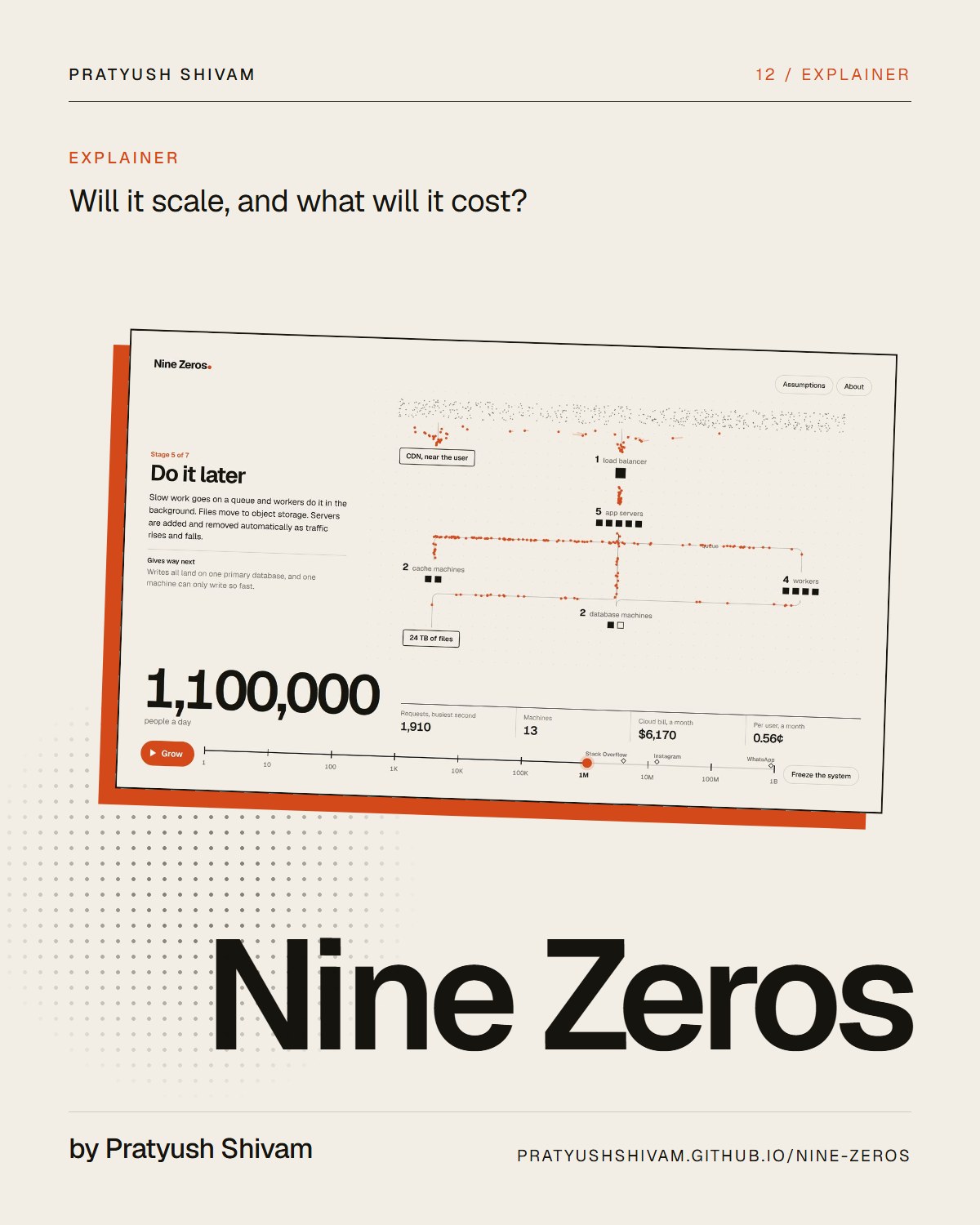
One slider, from one user to a billion. As you drag, the system redraws itself: one small server becomes a load balancer, a cache, a queue, shards and regions, with the monthly bill and cost per user beside it. Freeze the system and keep adding users to watch it slow down and fail.
The diagram moves through seven stages. At one user the app and database share a small server. At a thousand the database moves out, so losing the app server does not mean losing the data. At ten thousand a load balancer and a CDN arrive. At a hundred thousand a cache and read replicas mean nine requests in ten never touch the primary. Then come a queue and workers, then shards and a second region, then many regions and hundreds of shards.
02 · How it works
The traffic model
The model is pure functions in one file, with tests and no DOM. Traffic is daily users times requests per user, spread over a day, times a peak factor. App servers are peak requests divided by what one server can serve times how full it may run, with spare capacity once there is more than one region. Reads the cache cannot answer go to replicas, and writes and data size decide the number of shards.
03 · How it works
Why response time explodes
Freeze the system and the readout switches to what users feel. It uses the M/M/1 queue: the mean response is the service time divided by one minus the load, and the 99th percentile is the mean times the natural log of 100. So a server at 50% load takes twice as long as an idle one, at 90% ten times, at 98% fifty times, and past 100% the queue never empties.
04 · How it works
List prices, editable capacities
Cost is machines times the AWS on-demand list price for US East, plus storage and data transfer, checked on 11 November 2026. The capacities, such as 700 requests a second per app server and 4,000 reads per database machine, are rules of thumb rather than measurements of your system. That is why I made every assumption editable. The queueing formula, by contrast, is exact for the queue it describes.
05 · How it works
Real companies along the slider
Real companies are pinned along the way, each from what its own engineers published: Stack Overflow in 2016, Instagram in December 2011 and WhatsApp in 2015. They often ran on far fewer machines than the rules of thumb suggest. I kept them in because that gap is the point. The model adds machines where a good team would first remove work, and the real examples show what that looks like.
06 · What it teaches
The idea underneath
Nine Zeros shows two things people rarely expect. Cost per user collapses, from $12 for the first user to about half a cent each from a million onwards. And at large scale the biggest line on the bill is not servers but sending data to users, which no architecture removes. It also shows why a system at 95% load is one busy afternoon from down.
How it works, in one picture
How Nine Zeros works
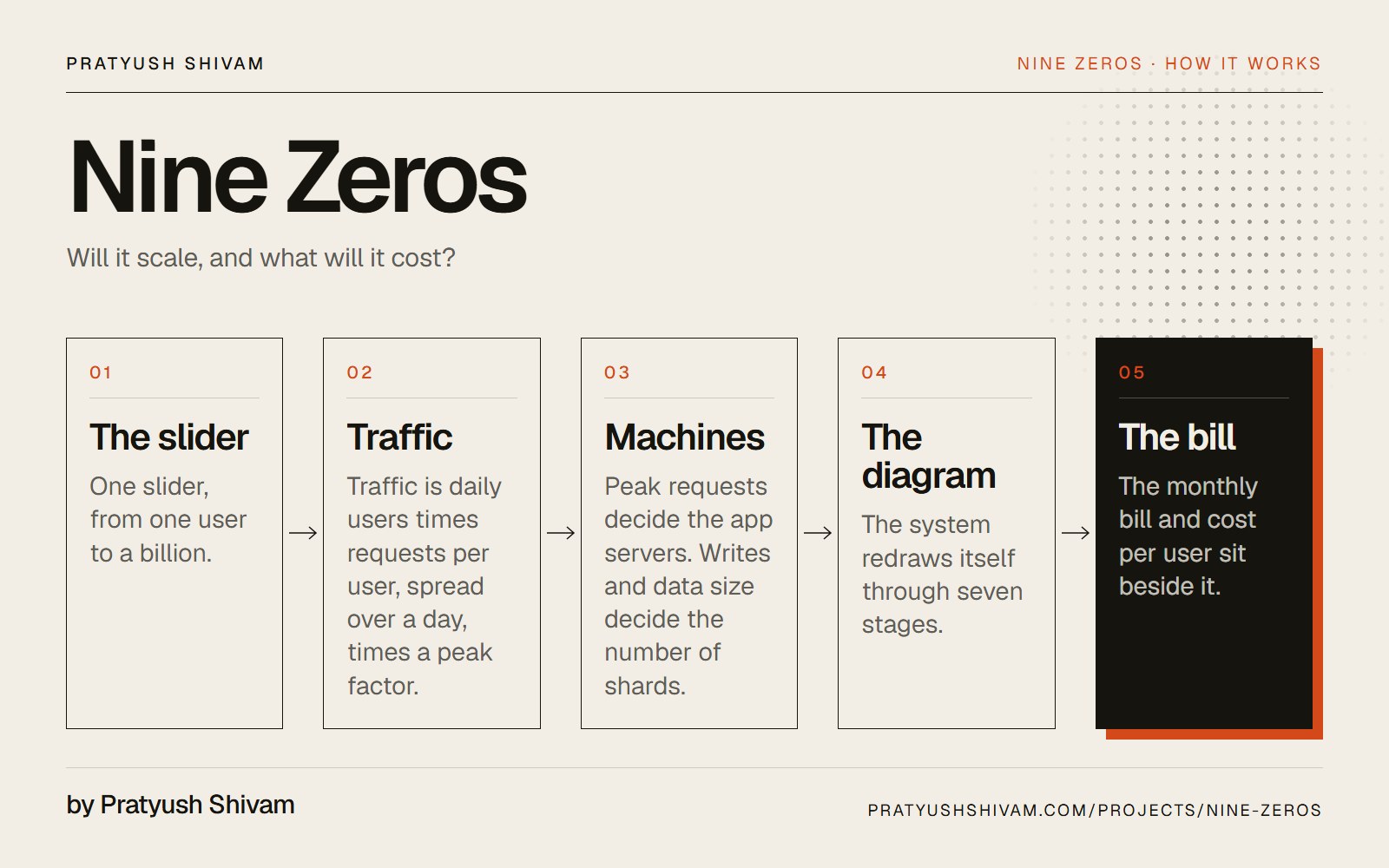
The slider → Traffic → Machines → The diagram → The bill. Open the picture to read it at full size.
1600 × 1000 · JPEG
Questions about Nine Zeros
01
How much does it cost per user to run an app at a million users?
With the model's default assumptions and AWS list prices, the cost per user falls to about half a cent from a million users onwards. Every assumption is editable, so you can change the figure to match your own app.
02
What does freezing the system show in Nine Zeros?
It stops the architecture growing while you keep adding users. The readout then shows load, typical response time, the slowest response in a hundred and the share of requests failing, so you can watch a system slow down and fail.
03
What does Nine Zeros leave out?
Salaries, which it does not count at all, and the discounts large customers negotiate. It also has no taste: it adds machines where a good team would first remove work, which is why real companies often need far fewer.
In numbers
Slider1 to 1,000,000,000Stages7Assumptions16, all editable
Poster
Nine Zeros poster
Nine Zeros on one sheet: a screen from it, its name and what it is. Free to use in pieces about the project, with a credit to Pratyush Shivam.