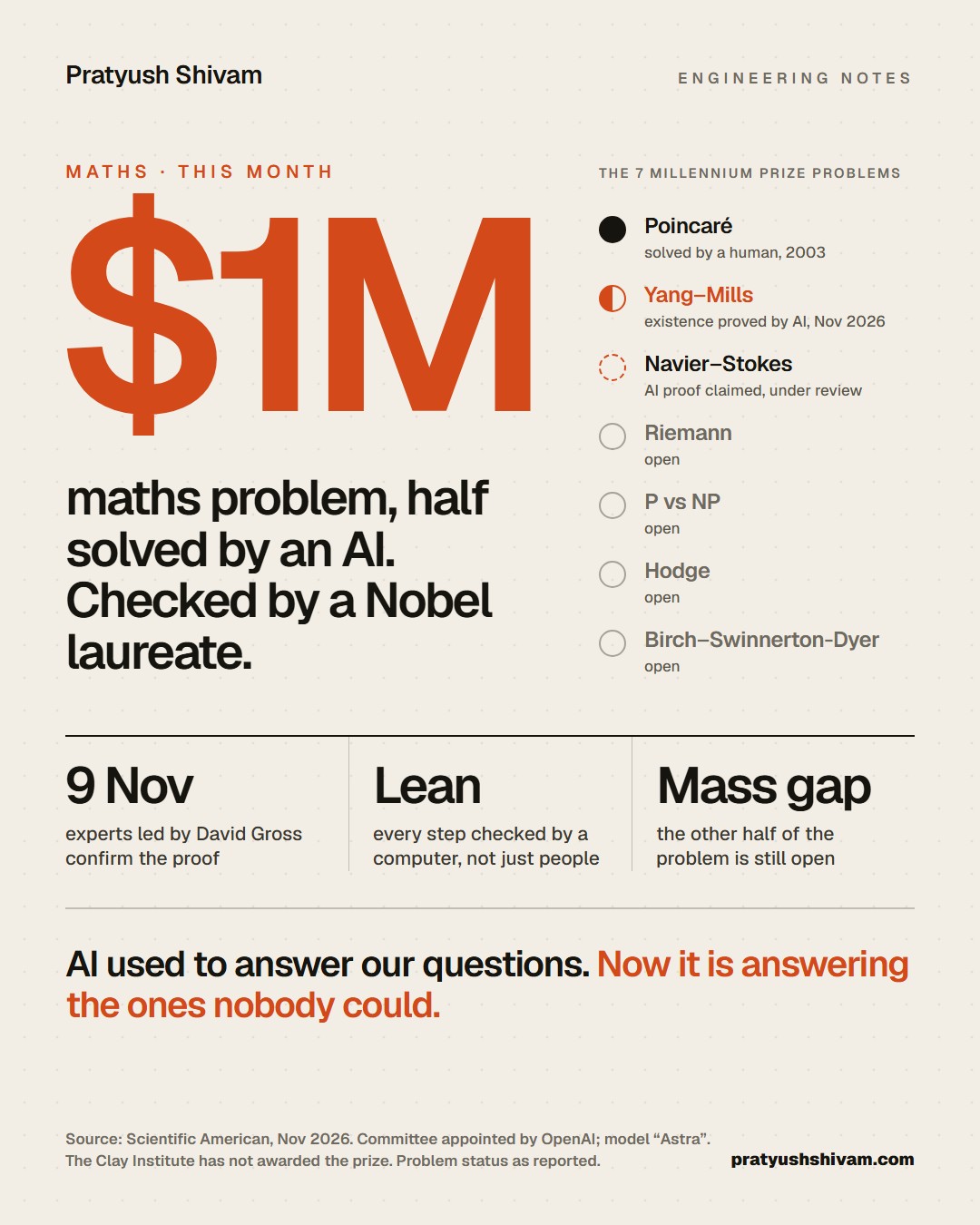
In 2000, mathematicians picked the 7 hardest problems they knew and put $1 million on each one.
In 26 years, humans have solved exactly one.
This month, an AI solved half of another.
On 9 November, a committee of experts led by Nobel laureate David Gross confirmed that an OpenAI model has proved the "existence" part of the Yang–Mills problem. Yang–Mills is the maths underneath the forces that hold atoms together. Physicists have used it for decades, but nobody could prove it holds up mathematically. The AI's proof is also written in Lean, so a computer has checked every step, not only people.
The caveats are real, and they matter
- The other half, the "mass gap", is still unsolved.
- OpenAI appointed the committee, and some mathematicians want the review done in the open.
- The committee itself says it does not fully understand the proof yet.
- The Clay Institute has not awarded anything.
Even so, think about what that last caveat means. A proof can now be correct, checked by a machine, and still be beyond the experts who are reviewing it.
For most of history the hard part of maths was finding the proof. Soon it may be understanding the proof an AI hands you.
Which of the remaining five would you bet falls next?
Source: Scientific American, November 2026.