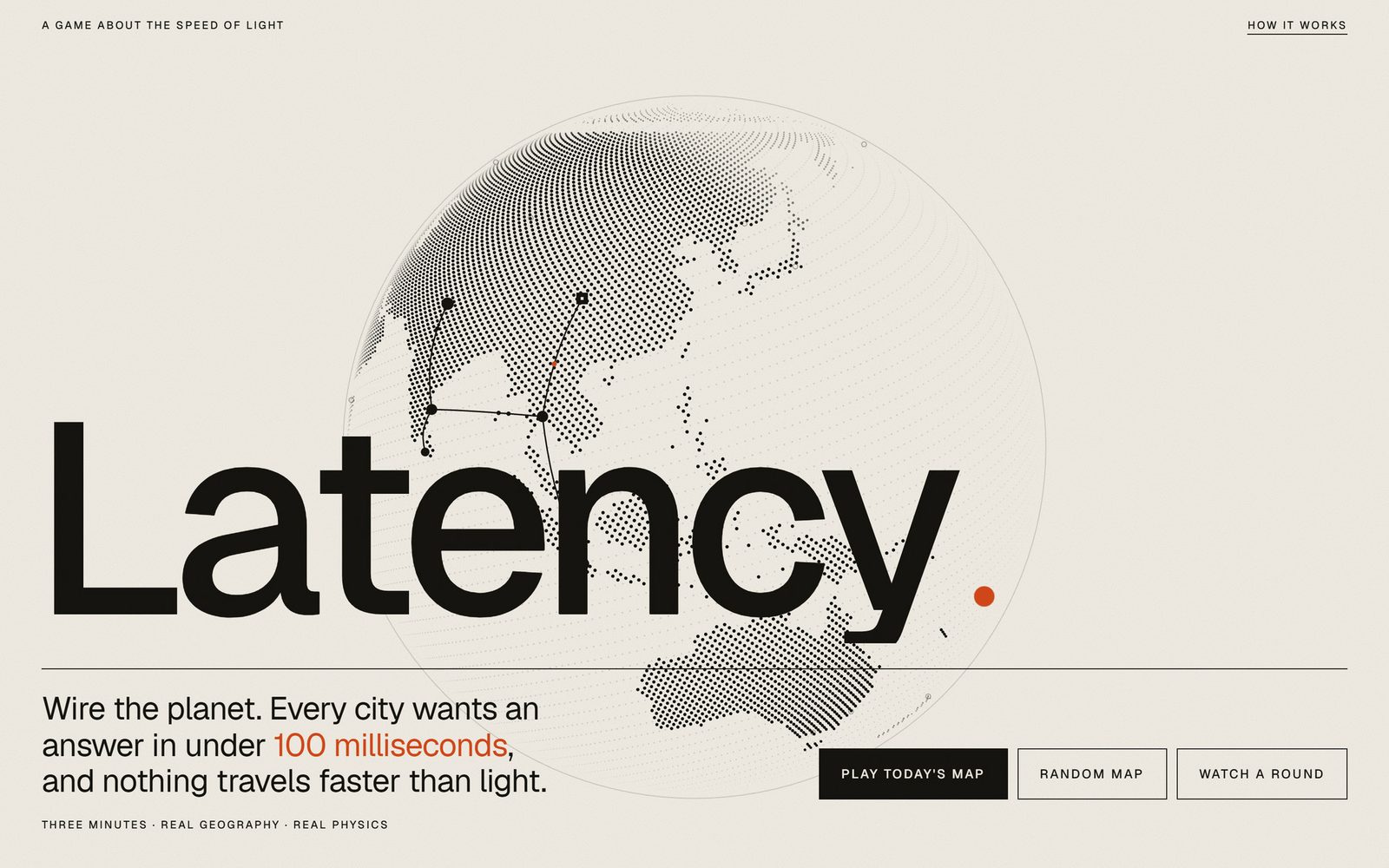
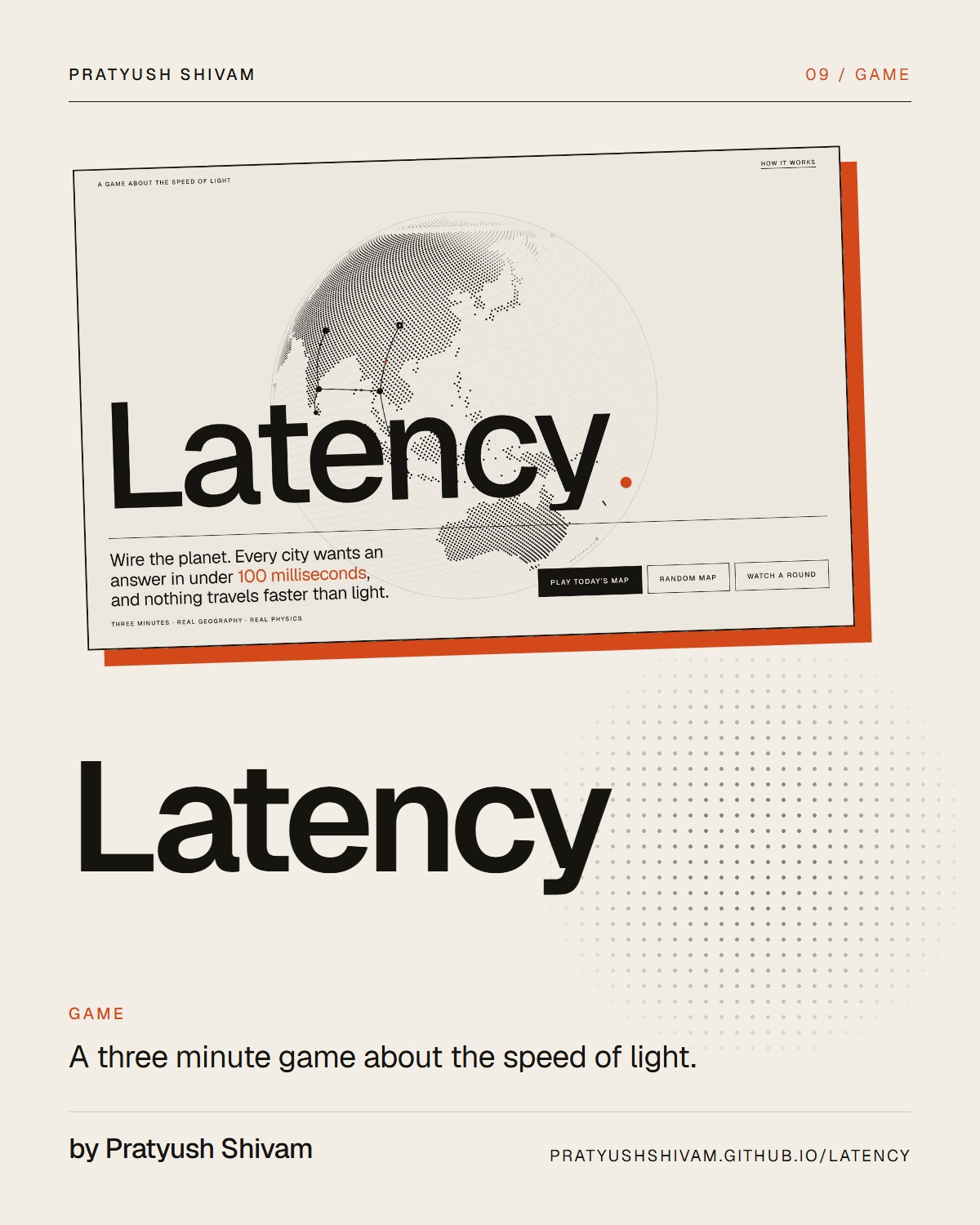
Cities light up and ask for service. You place data centres and lay cables so every city gets an answer in under 100 milliseconds. Signals travel at the real speed of light in fibre along great circles, so 100 ms buys 10,210 km and no more. The whole game follows from that one fact.
Light in vacuum travels at 299,792.458 km/s. In standard single-mode fibre it is slower by the group index of refraction, 1.4682, which gives about 204,190 km/s. A round trip is twice the path length divided by that speed, and distance is the great-circle distance by the haversine formula on a sphere of the Earth's mean radius. The Earth is 40,030 km round, so one data centre can reach a little over a quarter of the way round the planet.
02 · How it works
Routing with Dijkstra
Each city is served by the nearest working data centre along the cables. I compute that with one multi-source run of Dijkstra's algorithm over the cable graph, which gives every city its shortest path in a single pass. Peak demand is the square root of a city's population in millions, and it rises and falls with local solar time, so the busy part of the world moves round the globe as the round goes on.
03 · How it works
Failures that favour rings
From day two, cables are cut and data centres go down. A cable fault is a hazard per kilometre, so long cables and big networks are hit more often. The fault times are fixed by the map seed, so everyone playing the same day faces the same breaks. A tree has no spare path. A ring does. The score adds up the demand answered in under 100 ms across the whole round.
04 · How it works
A pure, seeded engine
The engine is plain TypeScript with no DOM, no clock and no Math.random. It advances in fixed 100 ms steps, so a round is decided by its seed and the player's moves alone. The same code runs in the browser, in the tests and in a greedy bot. That bot plays 24 maps to keep the rules balanced, and it also plays a round in front of you if you press Watch a round on the title screen.
05 · How it works
Drawing the globe
The globe is a field of points on a Fibonacci lattice, kept where the Natural Earth land mask says there is land and lit by the simulated sun. Signals on the cables are drawn at the speed of light in fibre divided by 20, so a 100 ms round trip takes two seconds on screen. Cities come from GeoNames. Prices, fault rates and the shape of the demand curve are game design, and the game says so.
06 · What it teaches
The idea underneath
Latency teaches the one limit engineering cannot remove: light is fast, but not instant. The latency in the game is a floor, since real cables do not follow great circles and routers add delay. The lesson still holds. The far side of the planet is out of reach from anywhere, and the only fix for distance is to be closer.
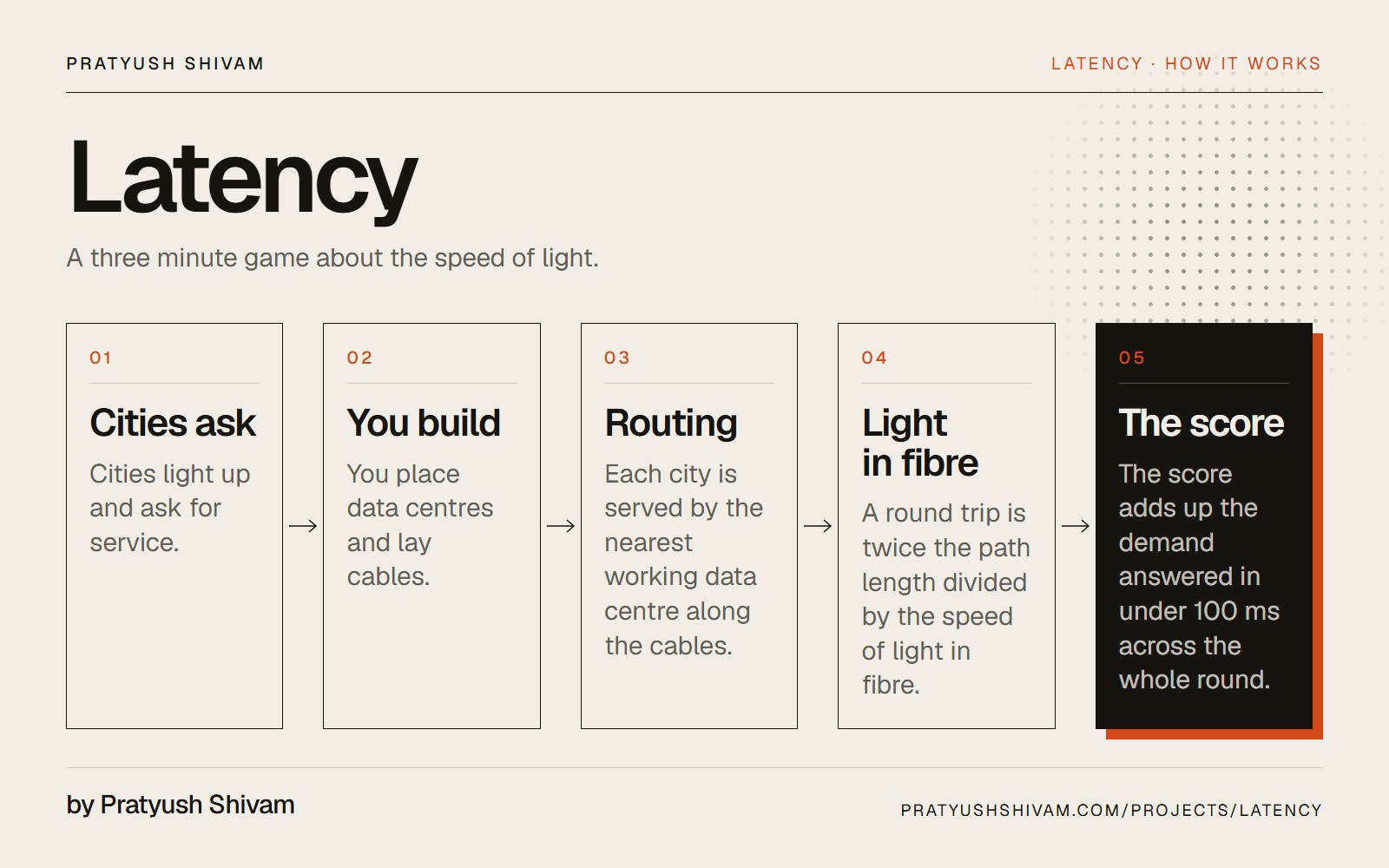
How it works, in one picture
How Latency works
Cities ask → You build → Routing → Light in fibre → The score. Open the picture to read it at full size.
1600 × 1000 · JPEG
Questions about Latency
01
How fast does light travel in optical fibre?
About 204,190 km/s in standard single-mode fibre, roughly two thirds of its speed in vacuum. Latency uses a group index of 1.4682 at 1550 nm, taken from the Corning SMF-28 Ultra product information sheet.
02
Why can one data centre not serve the whole world in under 100 ms?
Because the answer has to go out and come back. In 100 ms, light in fibre can serve a city at most 10,210 km of cable away, and the Earth is 40,030 km round, so the far side is always out of reach.
03
Is the Latency map the same for everyone?
Yes. Each day's map is seeded with the UTC date, which picks the cities, their order and the fault times, so everyone plays the same map that day and can compare scores.