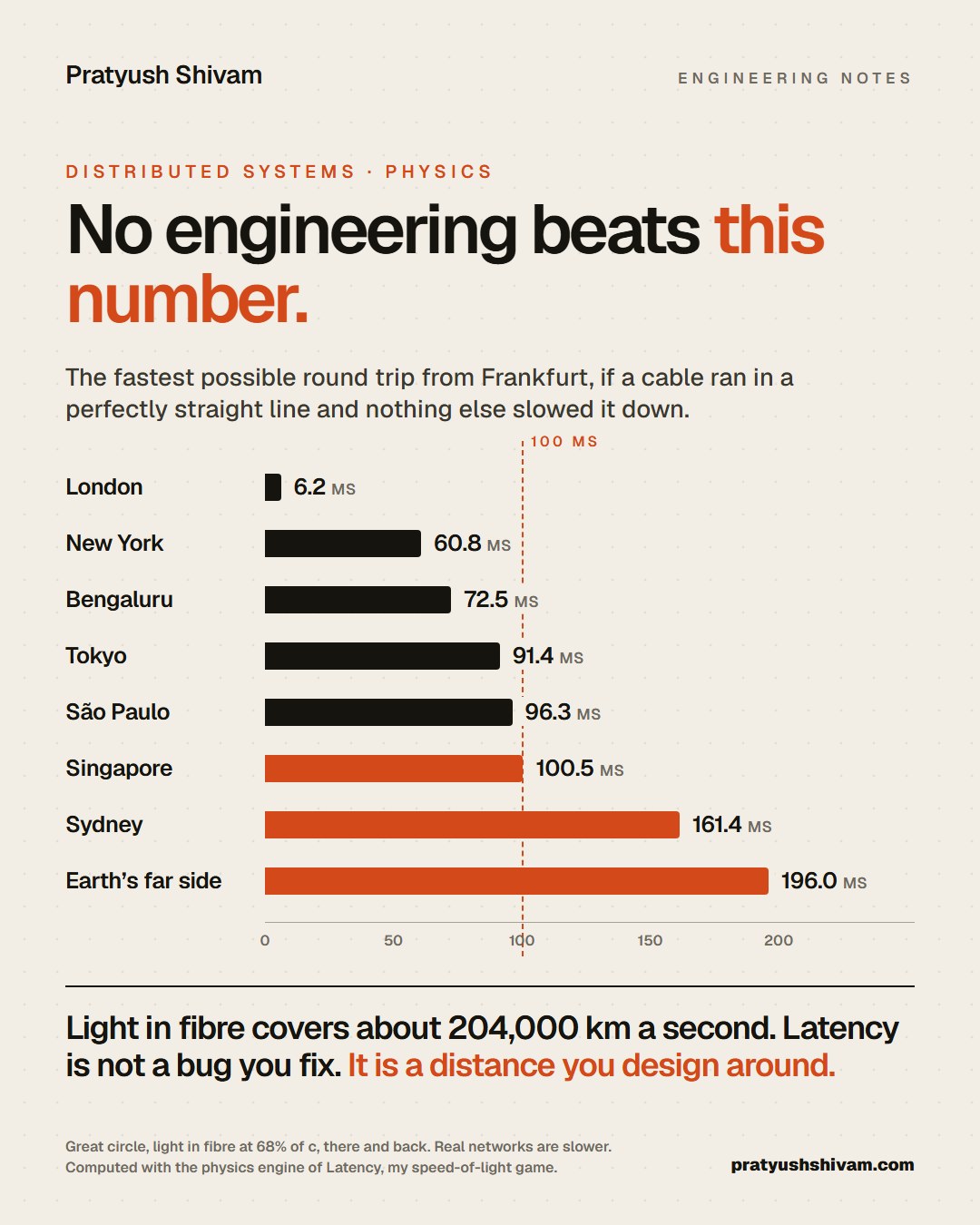
Frankfurt to Sydney and back can never take less than 161 milliseconds. Not with better code, not with a faster database, not with more servers in the same place.
That is physics. Light in optical fibre travels at about 204,000 km a second, 68% of its speed in vacuum, and a request has to go out and the answer has to come back. The chart is the best case: a cable running in a perfectly straight line, with nothing else in the way. Real networks are slower, because cables follow coastlines and every router adds time.
A few things this changes once you see it:
- 100 ms of round trip buys about 10,210 km of fibre. One data centre can serve a little over a quarter of the planet well. Nobody can serve the far side under 196 ms.
- "Make it faster" sometimes means "move it closer". The fix for a slow API in Singapore is often not in the code at all.
- Every extra round trip multiplies the distance. A page that makes five calls in a row from Frankfurt to Tokyo has spent half a second on physics before any work is done.
- It is why systems built for many places need many copies of the data, and why keeping those copies in agreement is one of the hard problems in distributed systems.
I built a small game around this limit. You get a globe and a budget, cities ask for answers in under 100 ms, and every latency in it is computed from the same physics as this chart. Nothing is made up, and the far side of the planet stays out of reach no matter what you build.
Play Latency: pratyushshivam.github.io/latency/
What is the longest round trip your users live with?