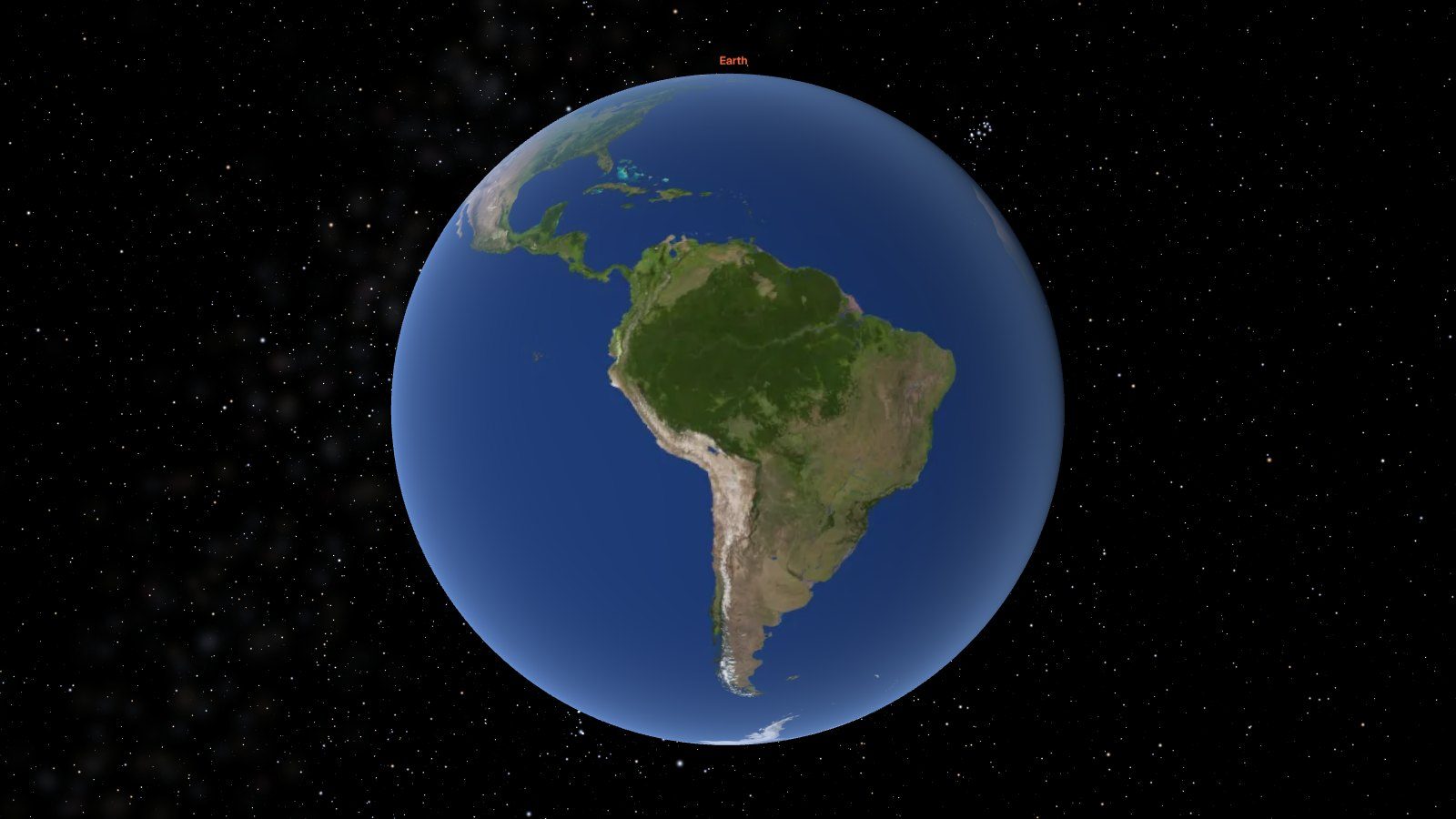
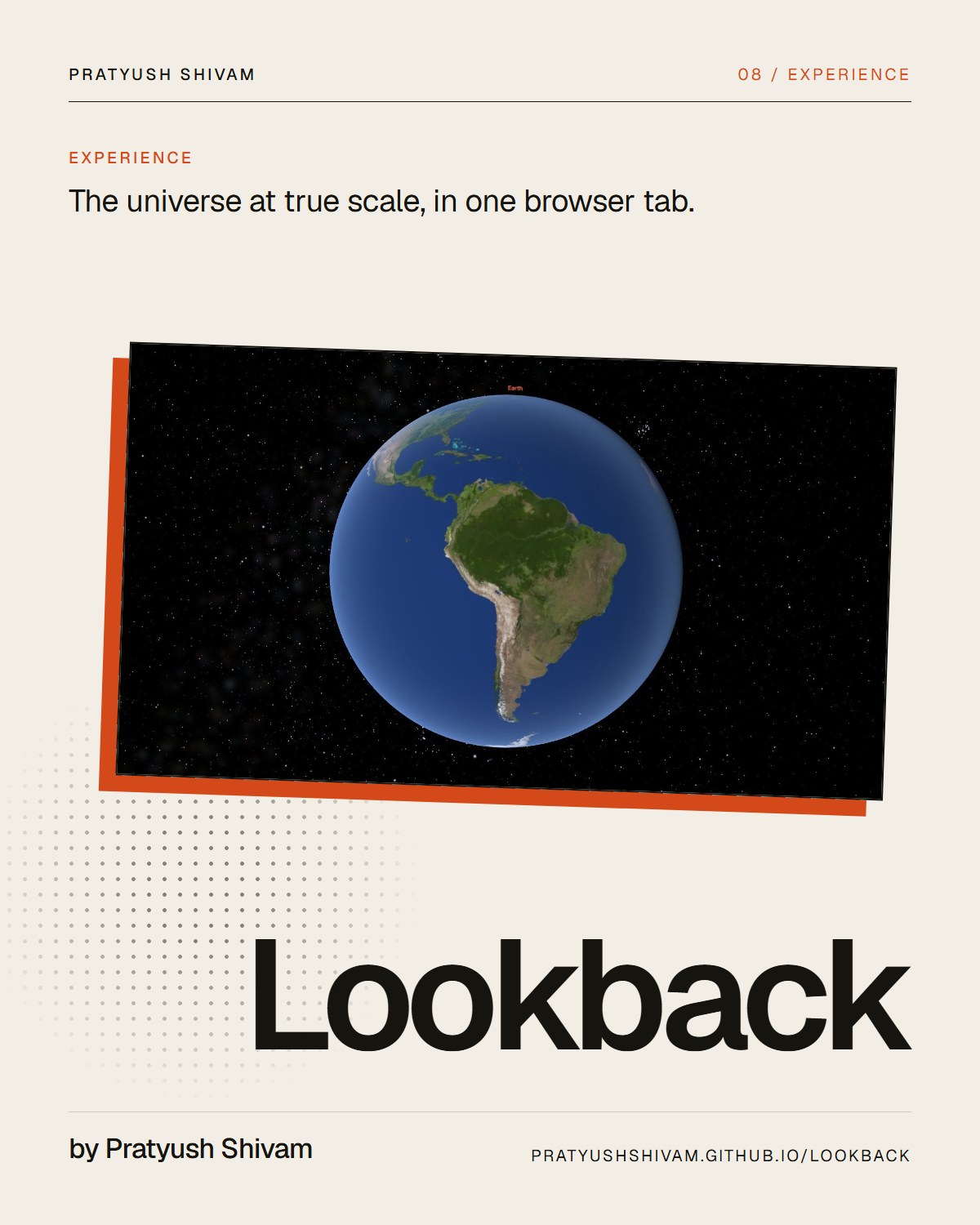
You start a few thousand kilometres above Earth and scroll out in one unbroken motion, past the Moon, the planets, the nearest stars and the Milky Way, to the edge of the observable universe. Every size and distance is real, the planets are where they are today, and the stars and galaxies come from real catalogues.
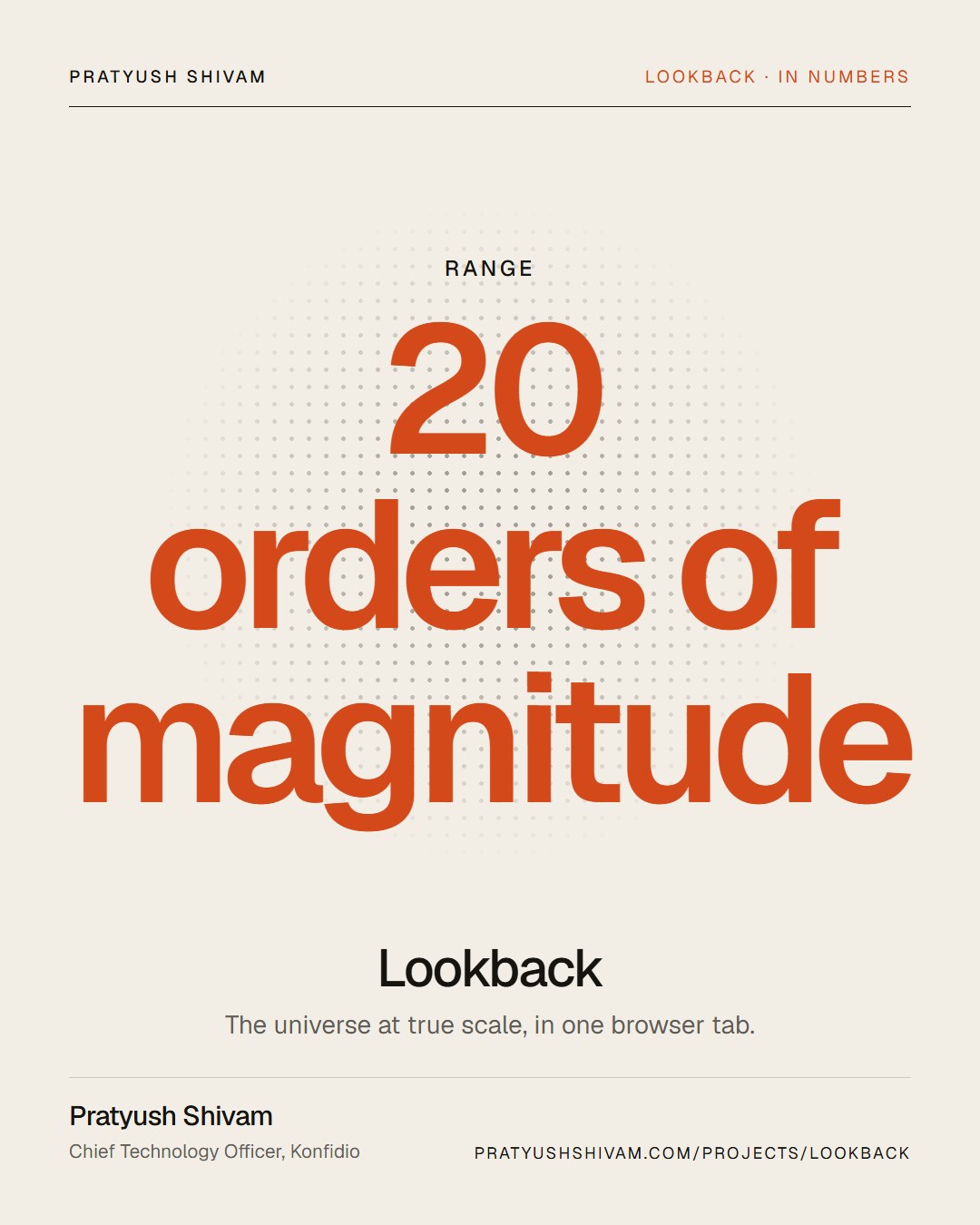
A graphics card works in 32-bit floats, about seven significant digits, but the radius of the Earth and the radius of the observable universe differ by twenty orders of magnitude. Put a planet at its real coordinates in a float and it shakes itself to pieces. So every object stores its position relative to its parent, Moon to Earth and Earth to Sun, in float64 metres, and the offset between two objects is summed through their nearest common ancestor.
02 · How it works
A camera with no position
The camera has no world position. It is a small offset from whatever it looks at, and everything is expressed relative to it in float64 before being narrowed to float32, so precision is best exactly where you are looking. Stars live in parsecs and galaxies in megaparsecs, and the camera's position reaches the shader as a high part and a low part. One test shows the naive approach losing a kilometre at Earth's distance from the Sun, where this keeps a micrometre.
03 · How it works
No depth buffer covers it
No depth range covers 1,000 km to 10^26 metres. Stars, galaxies and lines never touch the depth buffer. Solid bodies are drawn far to near, each with a depth range fitted round its own sphere, and since bodies in space do not intersect, nothing can flicker. Distance moves in log space, so one scroll notch multiplies your distance by the same factor, and the guided journey is a monotone spline through the landmarks, with no stops and no cuts.
04 · How it works
Eight bytes per star
Each star is packed into eight bytes: direction in two 16-bit numbers using octahedral encoding, distance in 16 bits on a log scale, and brightness and colour in 8 bits each. That puts 109,400 stars in 875 kB. The file is sorted by brightness from Earth and split in two, so a phone fetches the first 30,000 and still gets the familiar sky. Planet textures step up from a flat colour to 4,096 pixels as they grow, and are released again.
05 · How it works
Checked against the real sky
Planets use Kepler's equation with NASA JPL orbital elements, the Moon uses a series, and each body spins by IAU rotation models. The tests reproduce the Jupiter and Saturn conjunction of 21 December 2020, the close approach of Mars in October 2020, the solar eclipse of 8 April 2024 and the lunar eclipse of 14 March 2025. Distances past the Local Group come from redshift, in a flat universe with the Planck 2018 values.
06 · What it teaches
The idea underneath
Lookback shows that space is almost entirely distance. If Earth were a full stop, the Sun would be three and a half metres away and the nearest star a thousand kilometres. It also shows that looking out is looking back in time: the edge is 46.1 billion light-years away today, but its light set out 13.8 billion years ago.
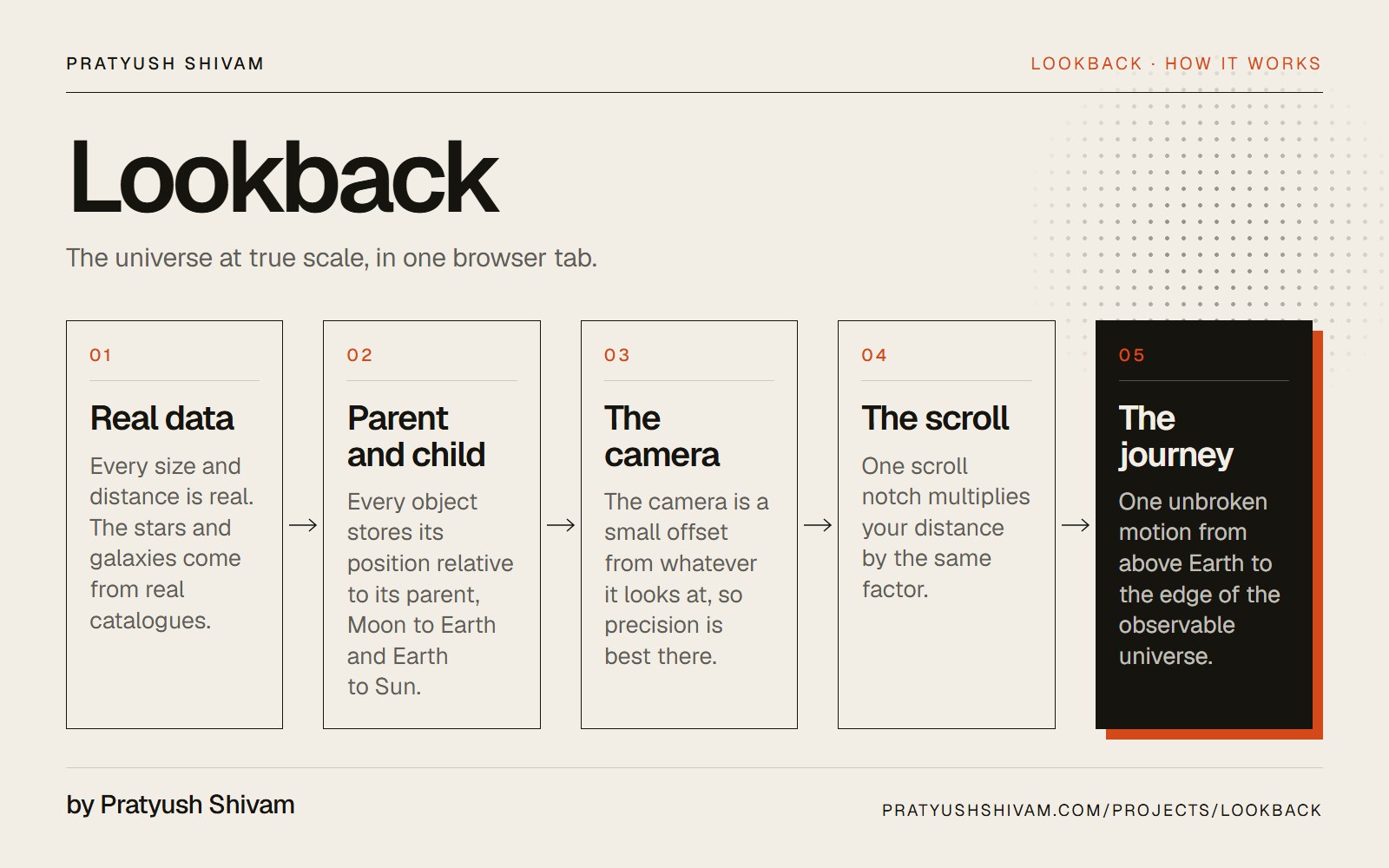
How it works, in one picture
How Lookback works
Real data → Parent and child → The camera → The scroll → The journey. Open the picture to read it at full size.
1600 × 1000 · JPEG
Film · 64 seconds
The entire universe, in a browser tab
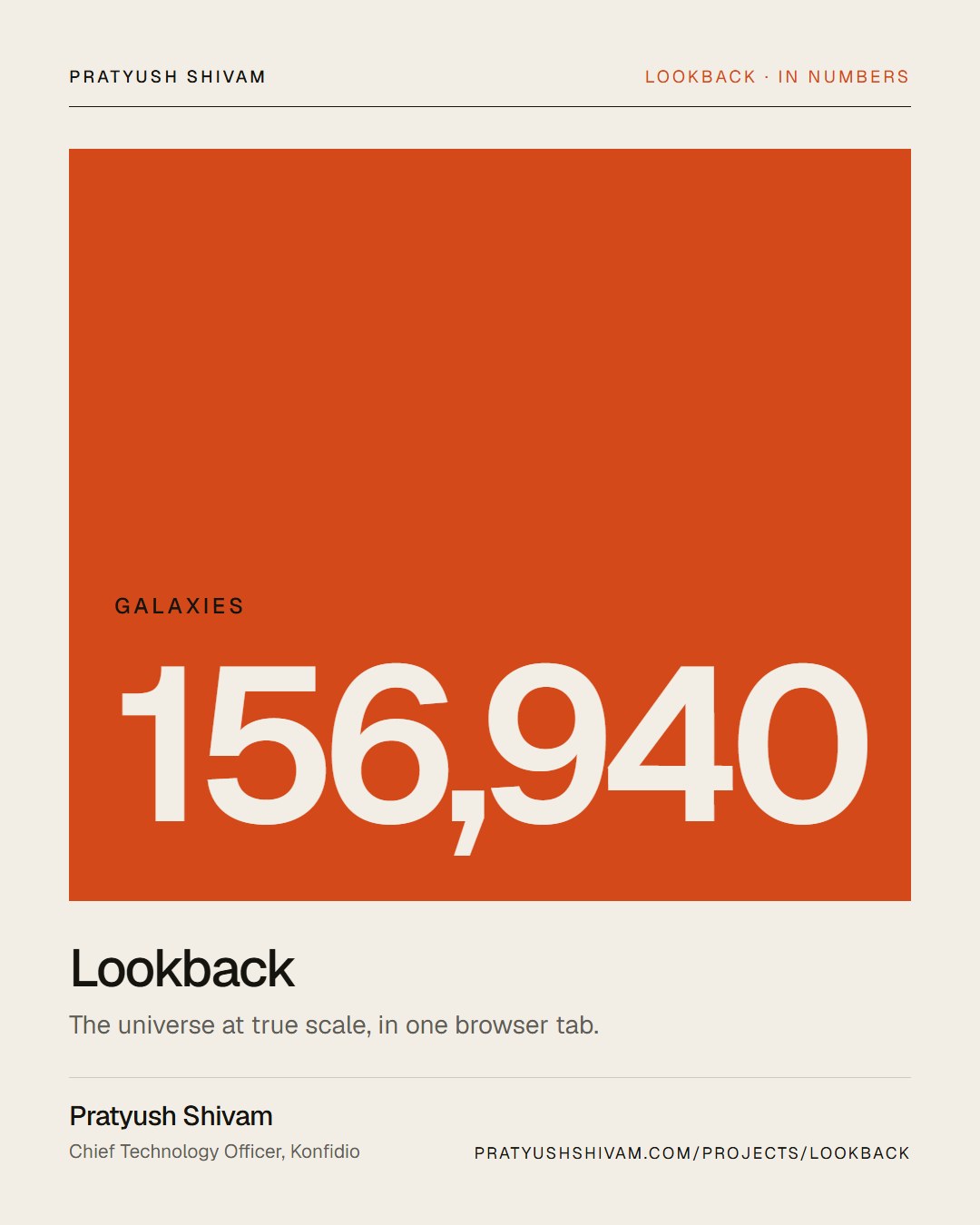
A film of Lookback, a page by Pratyush Shivam that pulls back from 19,000 km above Earth to the edge of the observable universe, 46.1 billion light-years away, in one continuous shot at true scale. It is real footage from the live page: the planets where they really are, 16,301 asteroids and Kuiper belt objects, 109,400 catalogued stars and 156,940 galaxies from the Sloan Digital Sky Survey, with a readout of the distance and the time light takes to cross it. The whole journey downloads in 2.95 MB.
Yes. Every size and distance is real, and the planets are where they are at the moment you open the page. Aids such as orbit lines, names and long exposure help you find things, and each one can be switched off.
02
Where does Lookback's star and galaxy data come from?
The stars are from the HYG catalogue 4.1, the galaxies from Sloan Digital Sky Survey Data Release 17, and asteroids and Kuiper belt objects from the JPL Small-Body Database. The Milky Way's shape is generated from the accepted model, not mapped.
03
Why is the edge 46.1 billion light-years away if the universe is 13.8 billion years old?
Because space stretched while the light was travelling. The light from the edge set out 13.8 billion years ago, but the place it left is now 46.1 billion light-years away. Lookback shows both numbers, and past the Local Group they come apart.