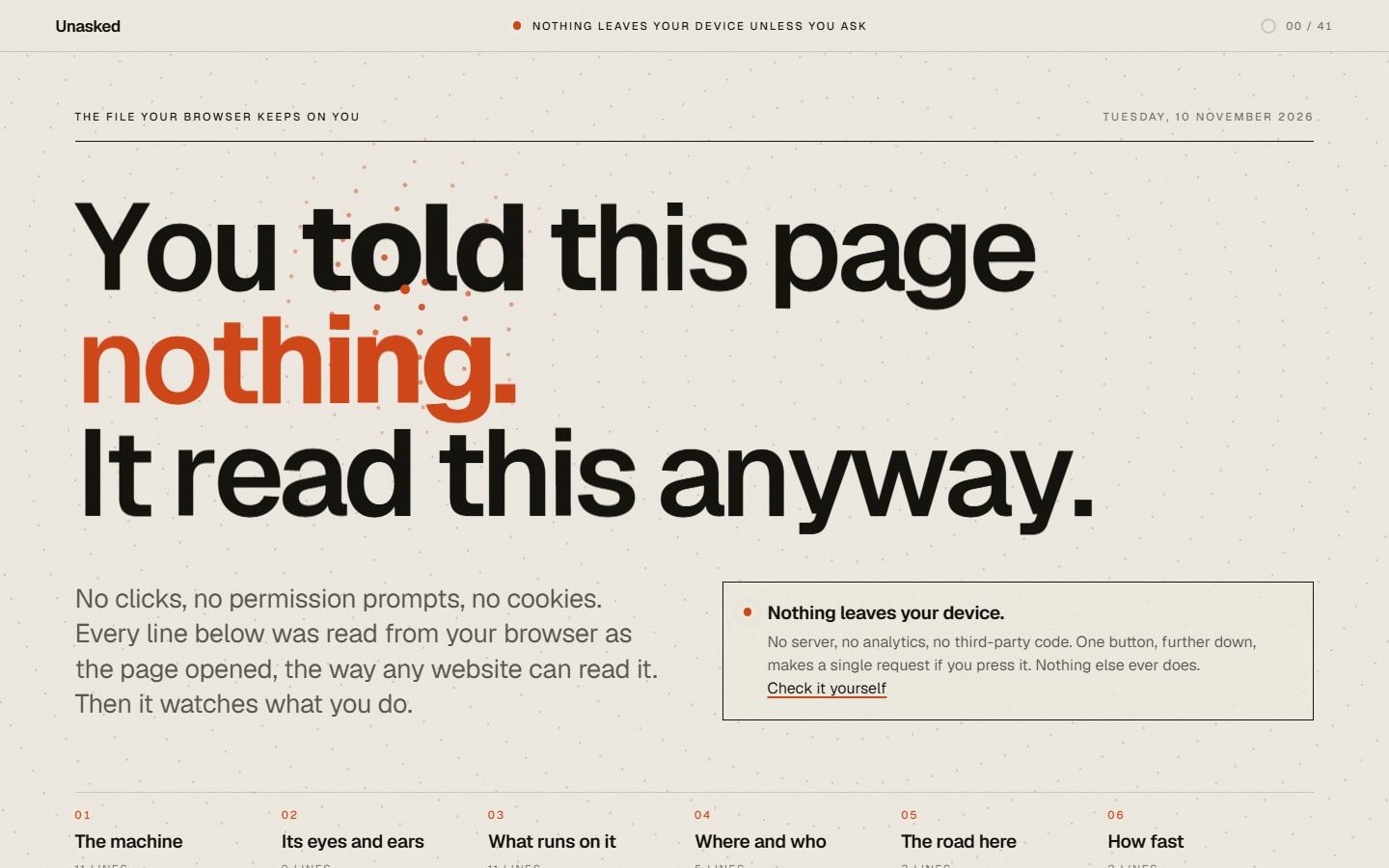
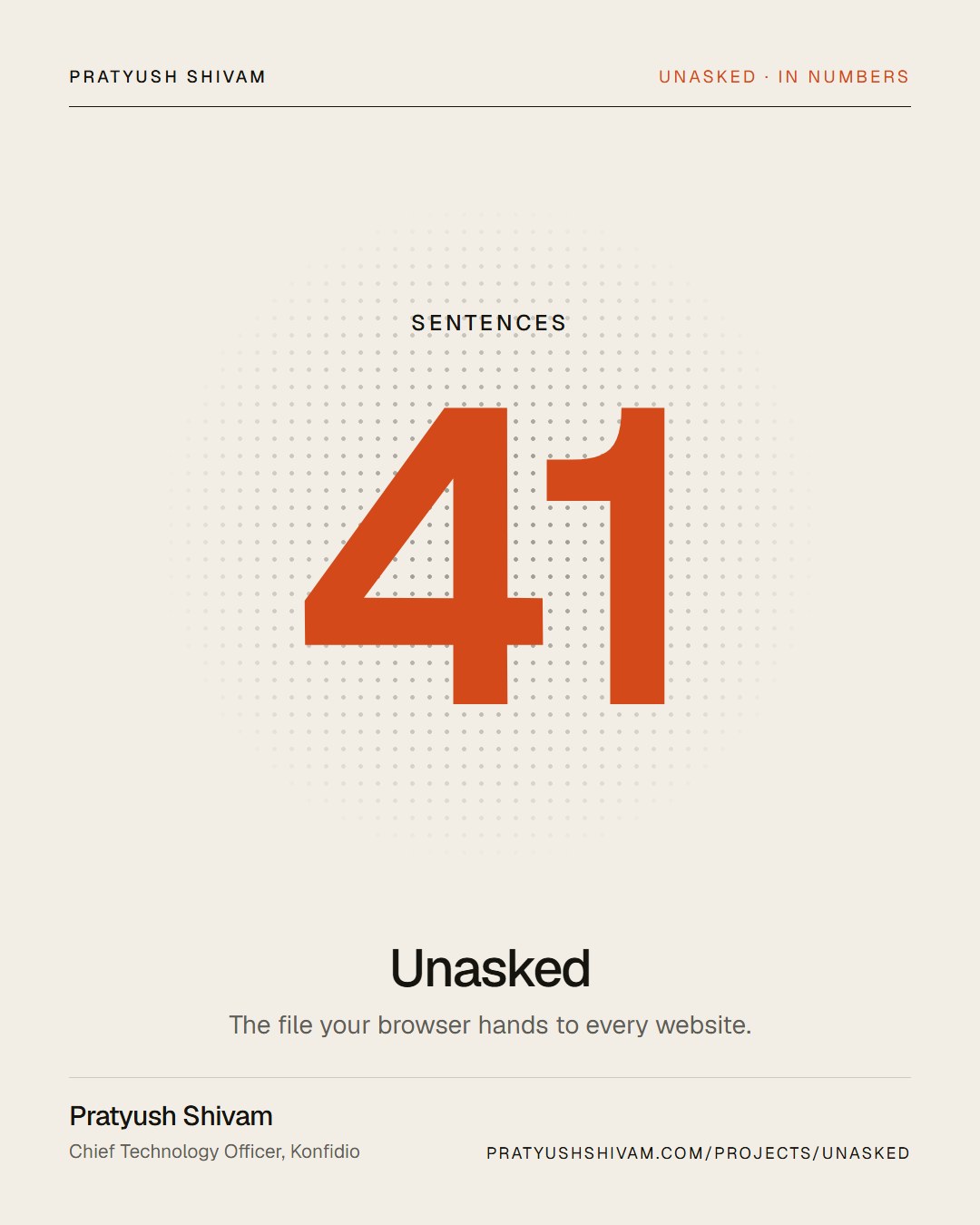
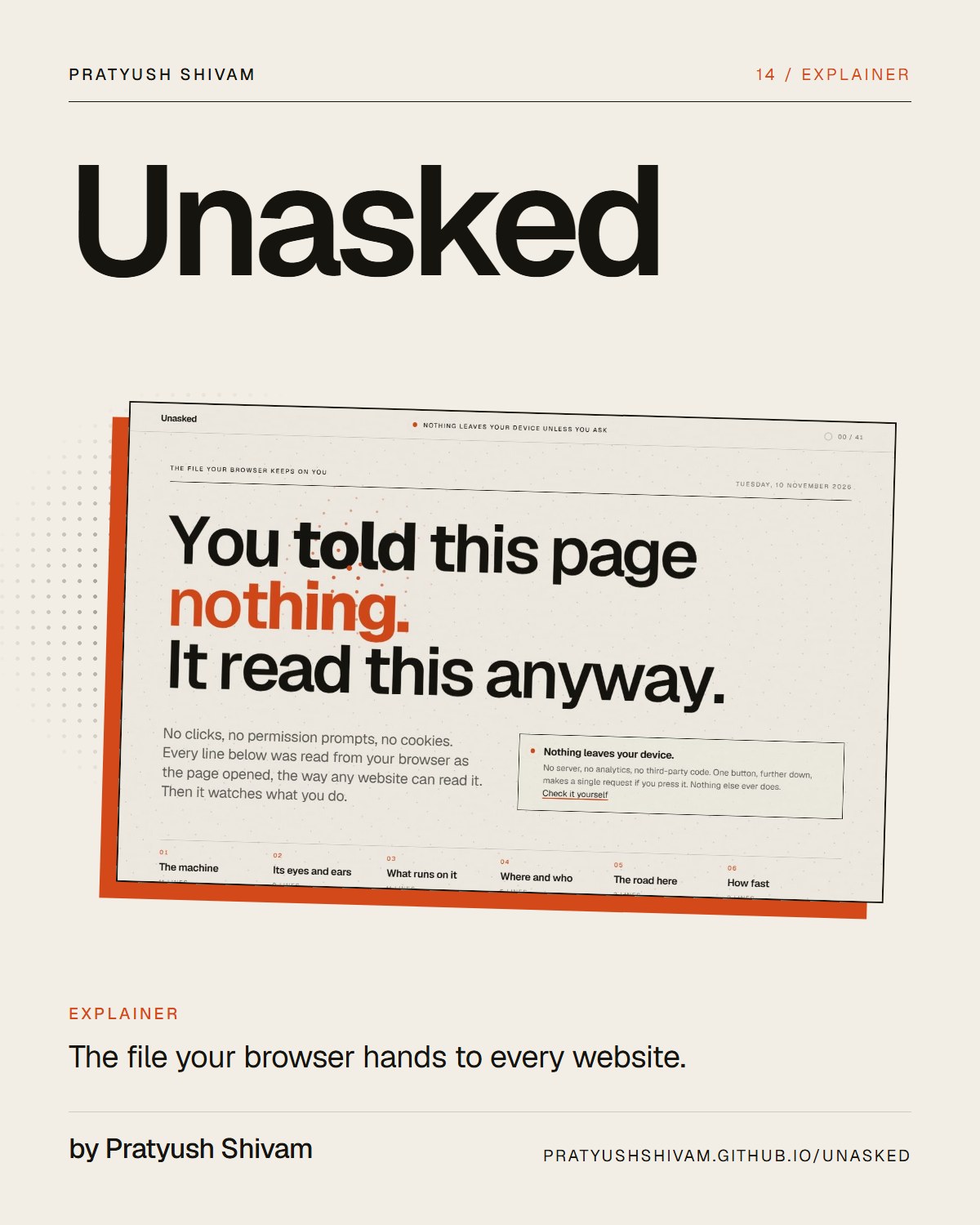
With no clicks and no permission prompts, the page writes out 41 plain sentences about you: your machine, your software, where you are and how you got here. Every line turns over to show how it was found and what reduces it. All of it is worked out on your own device.
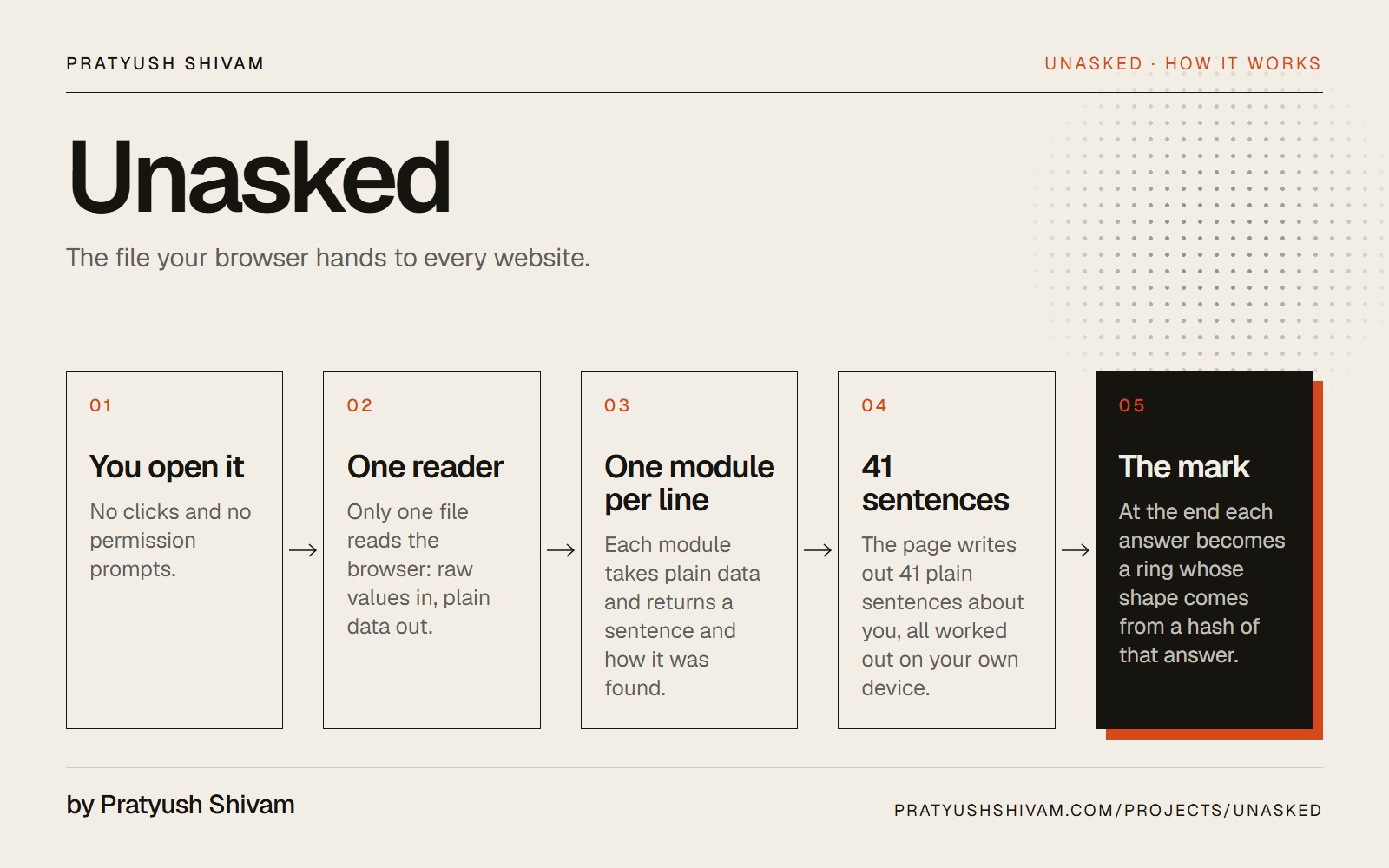
Each line is one small module. It takes plain data and returns a sentence, how it was found, what reduces it, and whether it stays steady between visits. Only one file reads the browser: raw values in, plain data out. The split matters for honesty as much as for testing, because the tests can hand a module a browser that refuses to answer and check that the line says kept back and nothing refused reaches the mark.
02 · How it works
Written for what browsers report today
Several signals have been cut back in recent years, and I wrote for what browsers say now. The system version comes only from client hints, because the old label is frozen. The storage figure is described as what it now is in Chromium, usage plus a fixed 10 GiB, not the size of your disk. Media devices are reported as at least one of each kind. The page never claims to detect a private window, because browsers closed those tricks.
03 · How it works
The mark, and what it will not claim
At the end each answer becomes a ring whose shape comes from a hash of that answer. Under the mark sit the first 64 bits of a SHA-256 hash of the steady answers, computed with the browser's own Web Crypto. The page does not tell you that you are one in N, because it cannot know without collecting everyone else's answers. It explains bits of identifying information instead, and why correlated answers make a simple sum overstate things.
04 · How it works
Nothing leaves, and you can check
The first tag in the page is a Content-Security-Policy. It sets default-src to none and allows exactly one outside address, ipinfo.io, used only if you press the button that asks for your public address. The browser refuses every other request from the page. The built script contains exactly one fetch call, and the build fails otherwise. A Chrome check also fails if any request is made after loading or a cookie is set.
05 · What it teaches
The idea underneath
Unasked shows that a website needs neither cookies nor permission prompts to tell browsers apart. An answer shared by half of all browsers carries one bit, bits add up when answers are unrelated, and 33 bits are enough to tell apart everyone alive. It also shows that a private window and a VPN leave almost all of this untouched.
How it works, in one picture
How Unasked works
You open it → One reader → One module per line → 41 sentences → The mark. Open the picture to read it at full size.
1600 × 1000 · JPEG
Questions about Unasked
01
What is browser fingerprinting?
It is telling browsers apart by the details they give any page without asking: screen, graphics chip, fonts, time zone, languages and more. No single detail is unique, but together they can single out one browser, even with cookies cleared.
02
How unique is my browser?
Unasked will not give you a one-in-N figure, because that needs everyone else's answers. It quotes two consented studies: 83.6% of 470,161 browsers were unique in the EFF's Panopticlick study in 2010, and 33.6% of 2,067,942 on a French website in 2018.
03
Does a VPN or private window stop fingerprinting?
Mostly not. A VPN changes your address and a private window clears storage, but almost everything Unasked reads is untouched. The page suggests turning on your browser's own fingerprinting protection and blocking third-party scripts instead.
In numbers
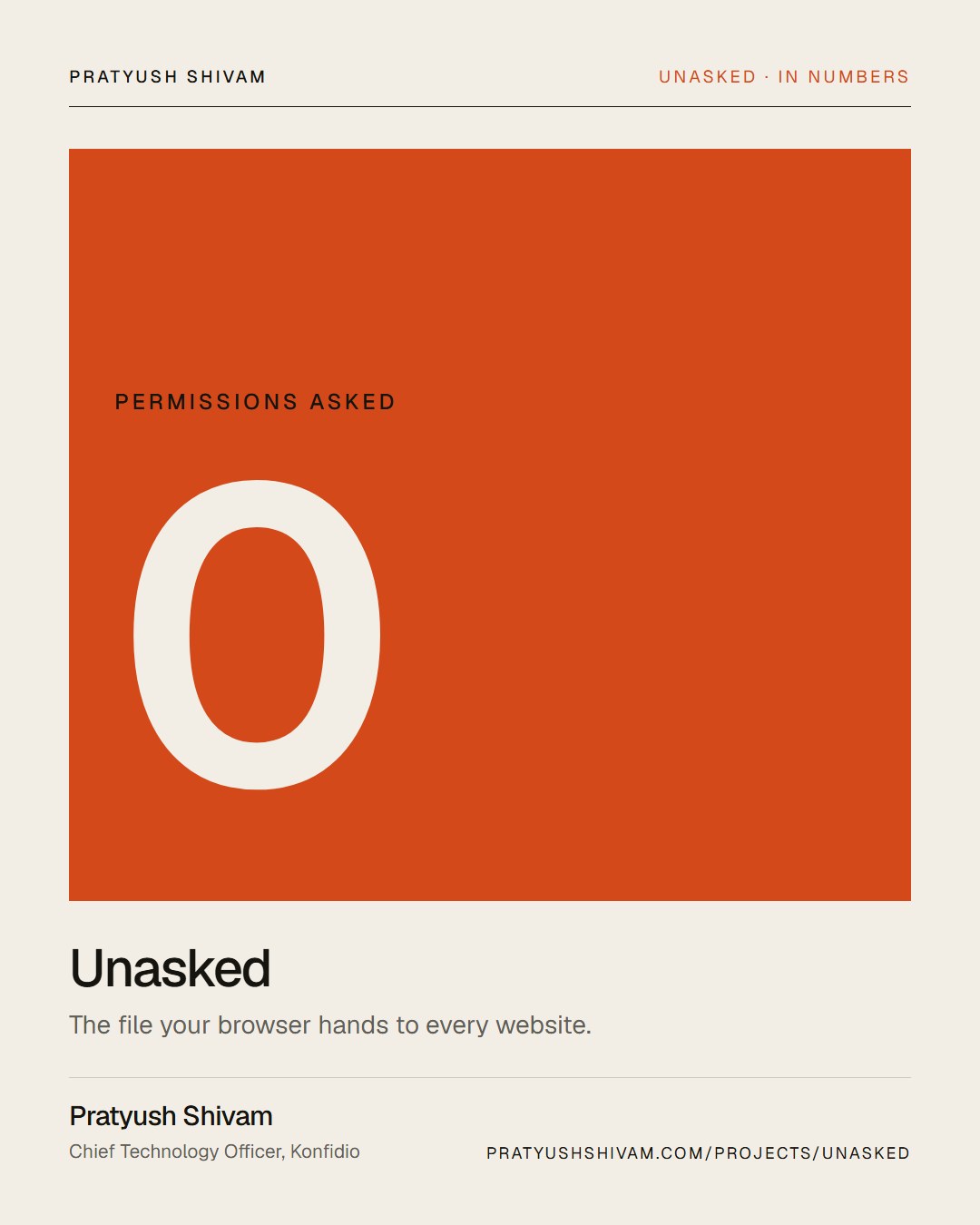
Sentences41Permissions asked0
Poster
Unasked poster
Unasked on one sheet: a screen from it, its name and what it is. Free to use in pieces about the project, with a credit to Pratyush Shivam.