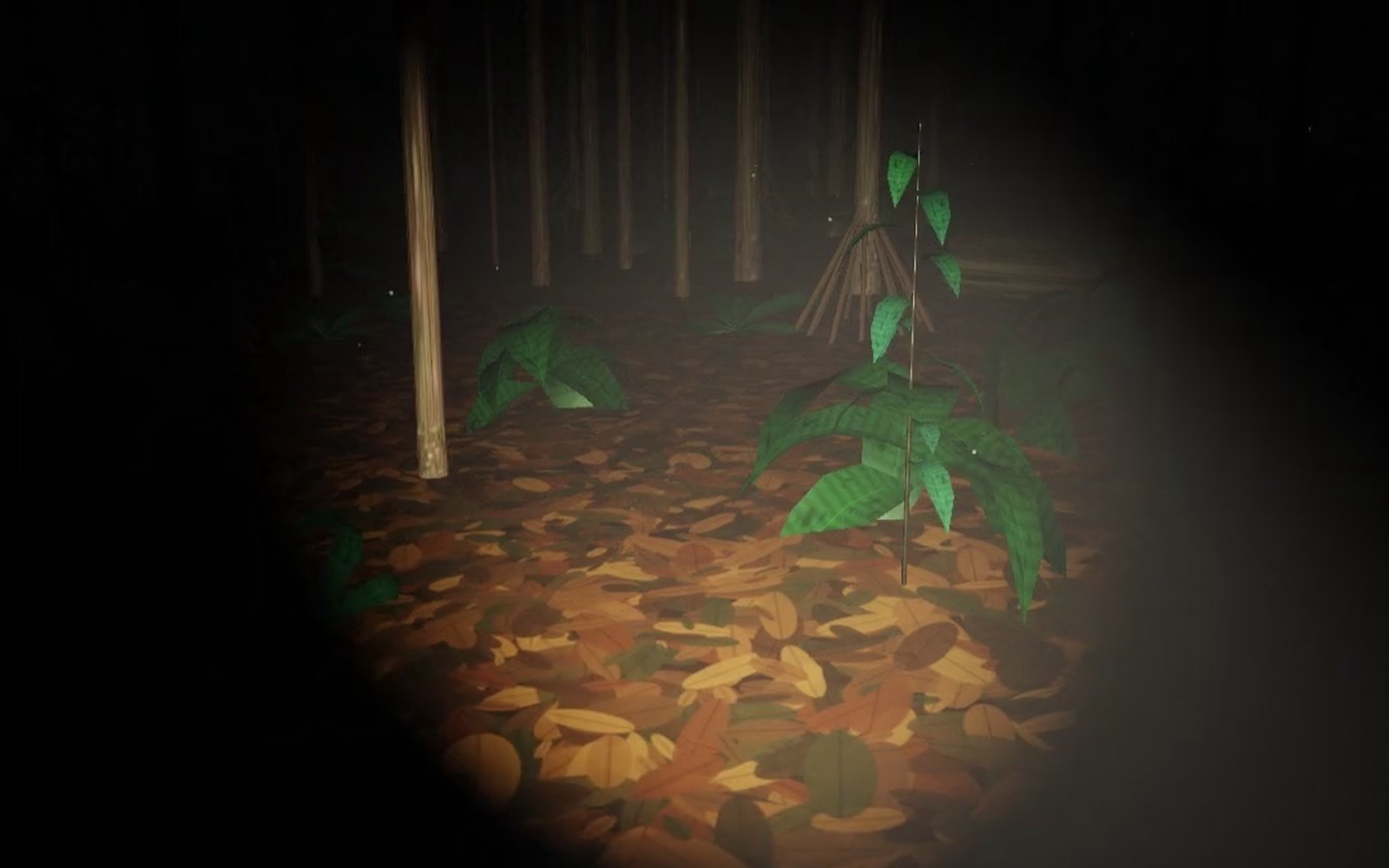
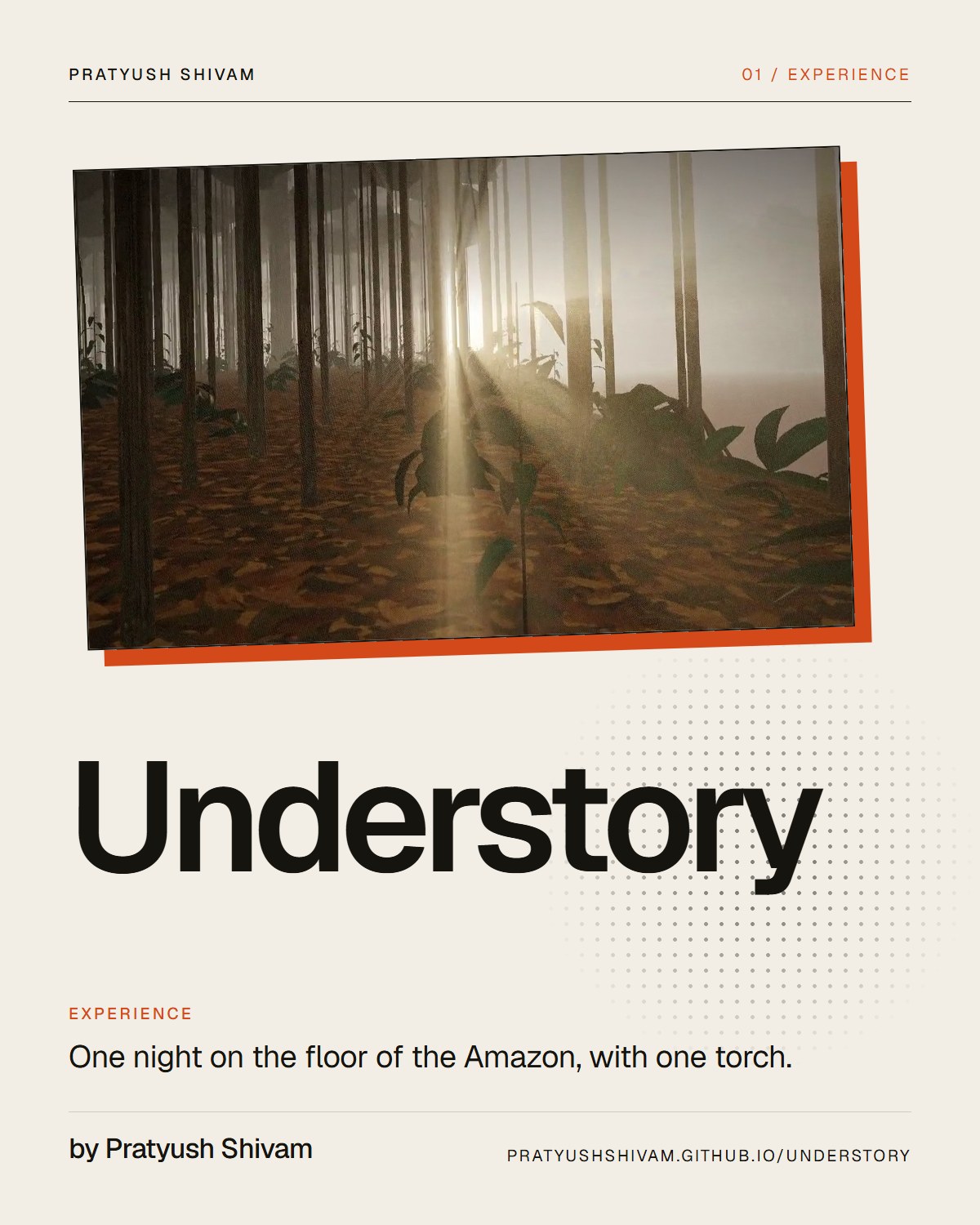
You stand in lowland rainforest at Yasuní, in Ecuador, as the light goes. Your torch shows a cone of wet leaves, trunks and mist, and everything else is black and full of sound. Eyes shine back at you in the colour each animal's eyes really shine. The whole night, 17:45 to 06:25, plays in about ten minutes. Every animal in it has a record from this forest, sits at the height it really lives at and is out at the hours it is really out. Most of them you will only hear.
The place is terra firme forest at Tiputini Biodiversity Station in Yasuní, Ecuador. The page grows 4 hectares at 702 trees per hectare, one in ten a stilt palm, as counted on the 25-hectare Yasuní plot, with heights from the published curve for western Amazonia. The position of each tree is generated, not surveyed. About 2,400 trunks, 5,400 understory plants and 560 animals are instanced, with one draw call per species and per forest chunk.
02 · How it works
One torch, no shadow maps
The torch is at your eye, so its shadows hide behind the things that cast them and no shadow maps are needed. Mist in the beam is 14 steps of ray marching in one full-screen pass, 8 on phones, and the same pass does the dawn shafts, tone mapping and grain. Light on the forest floor is 1.5% of open sky, and twilight follows the standard illuminance values for the Sun's angle. If the frame rate drops, resolution is lowered before anything else.
03 · How it works
Eyes that shine back
Eyeshine is your own torch, returned. Its brightness falls with the fourth power of distance and with the area of the pupil, and animals with no reflecting layer behind the eye do not shine at all. It is computed per eye on the CPU by the same function the tests check. Most colours follow the animal's group: frogs and spiders green, owls, opossums and rodents red, cats golden, caimans red-orange. Where a colour is an assumption, the animal's card says so.
04 · How it works
Sound you can walk towards
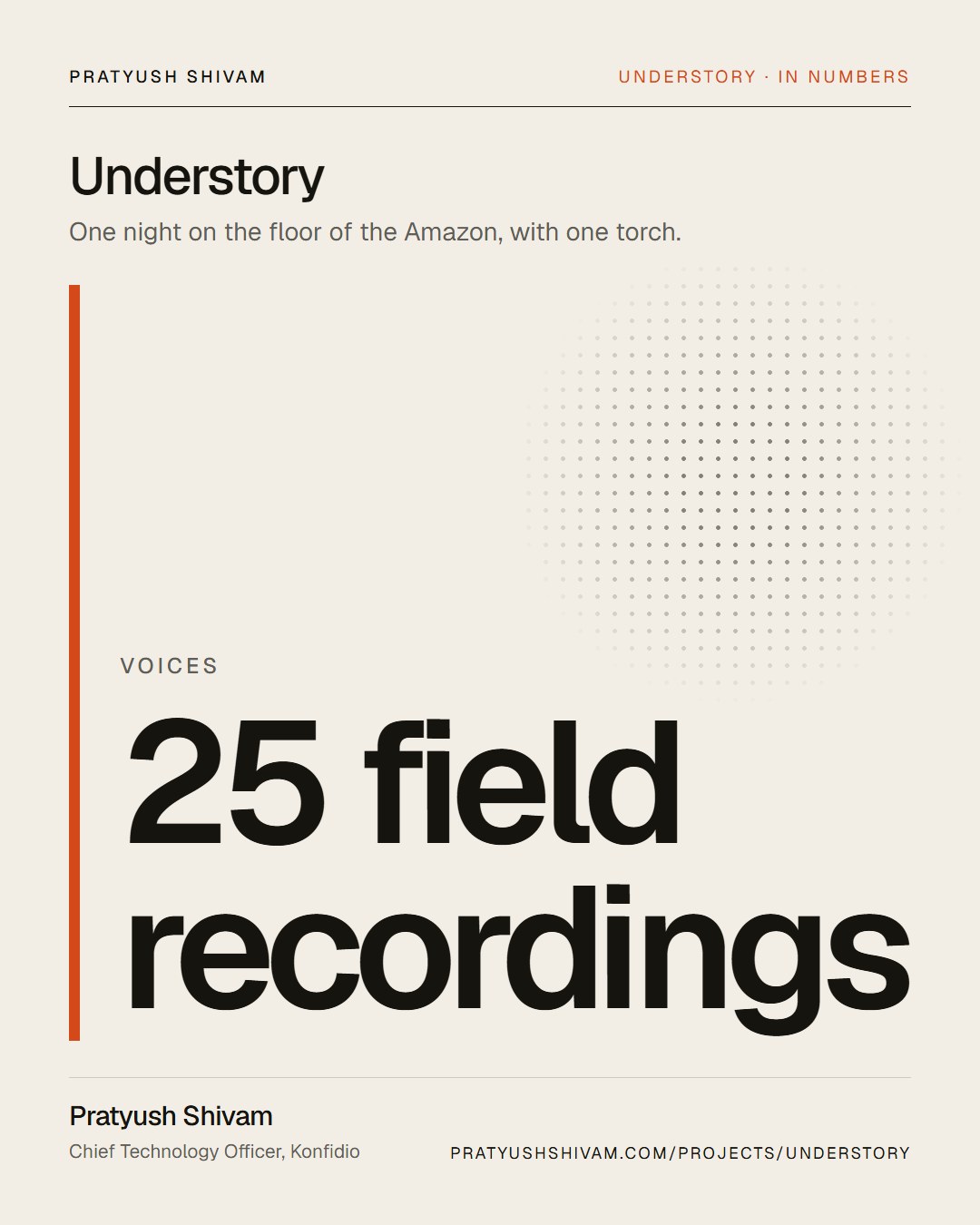
Every voice belongs to a placed animal. There are 25 field recordings from xeno-canto, each trimmed to one clear call and played from where that animal sits through an HRTF panner, so with headphones you can turn towards a call and walk to it. Level falls 6 dB per doubling of distance, plus the forest's own loss, which rises with pitch, so the howler carries across the whole site and a katydid a few tens of metres. Katydids, crickets and cicadas are synthesised.
05 · How it works
Every animal in its place and hour
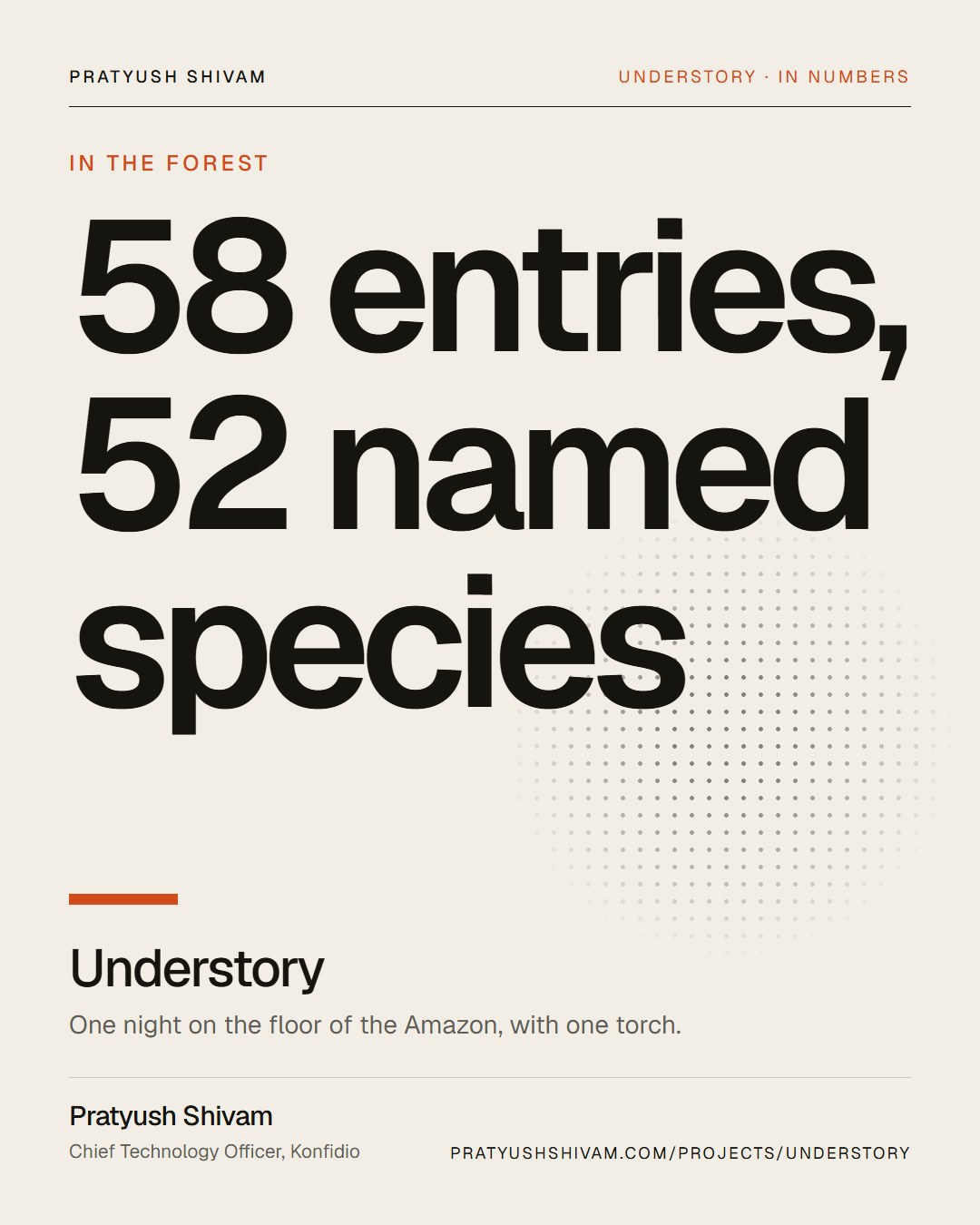
There are 58 entries: 52 named species, 5 insect and spider groups and one fungus that has no name yet. Each has a record from Tiputini or the Yasuní reserve, sits where it really lives and is out only in its own hours. The night runs from 17:45 to 06:25 in about ten minutes, slower at dusk and dawn. Each night has a number taken from the date, and the same number gives everyone the same trees, the same animals and rain at the same minute. 52 tests cover the core.
06 · What it teaches
The idea underneath
Understory teaches that a rainforest at night is mostly heard, not seen. About 560 animals are placed around you each night, and at dawn the notebook tells you how many were there all night and never let you know. It also shows why eyeshine fades so quickly with distance: the light spreads on the way out and again on the way back.
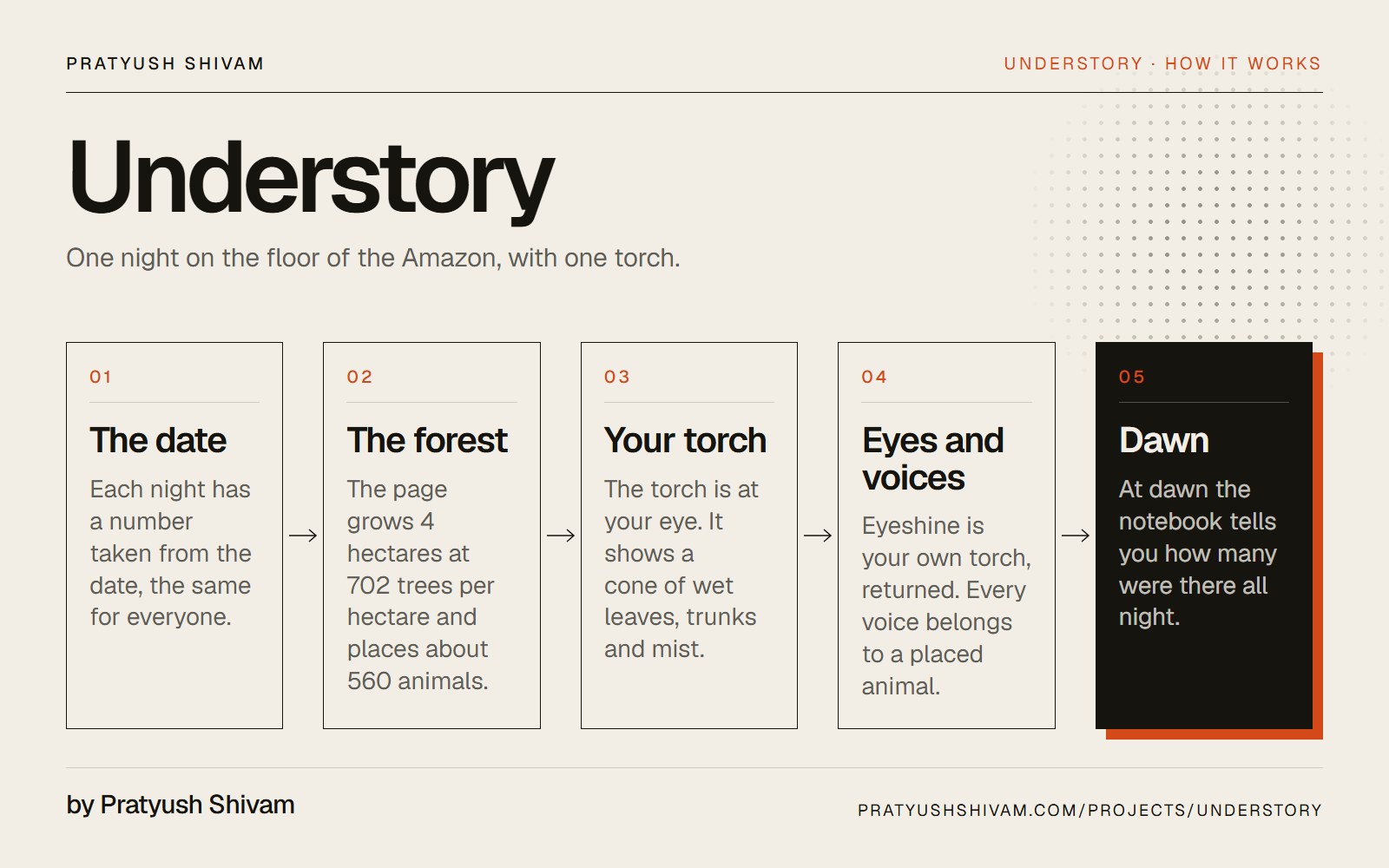
How it works, in one picture
How Understory works
The date → The forest → Your torch → Eyes and voices → Dawn. Open the picture to read it at full size.
1600 × 1000 · JPEG
Film · 61 seconds
One night in the Amazon, in a browser tab
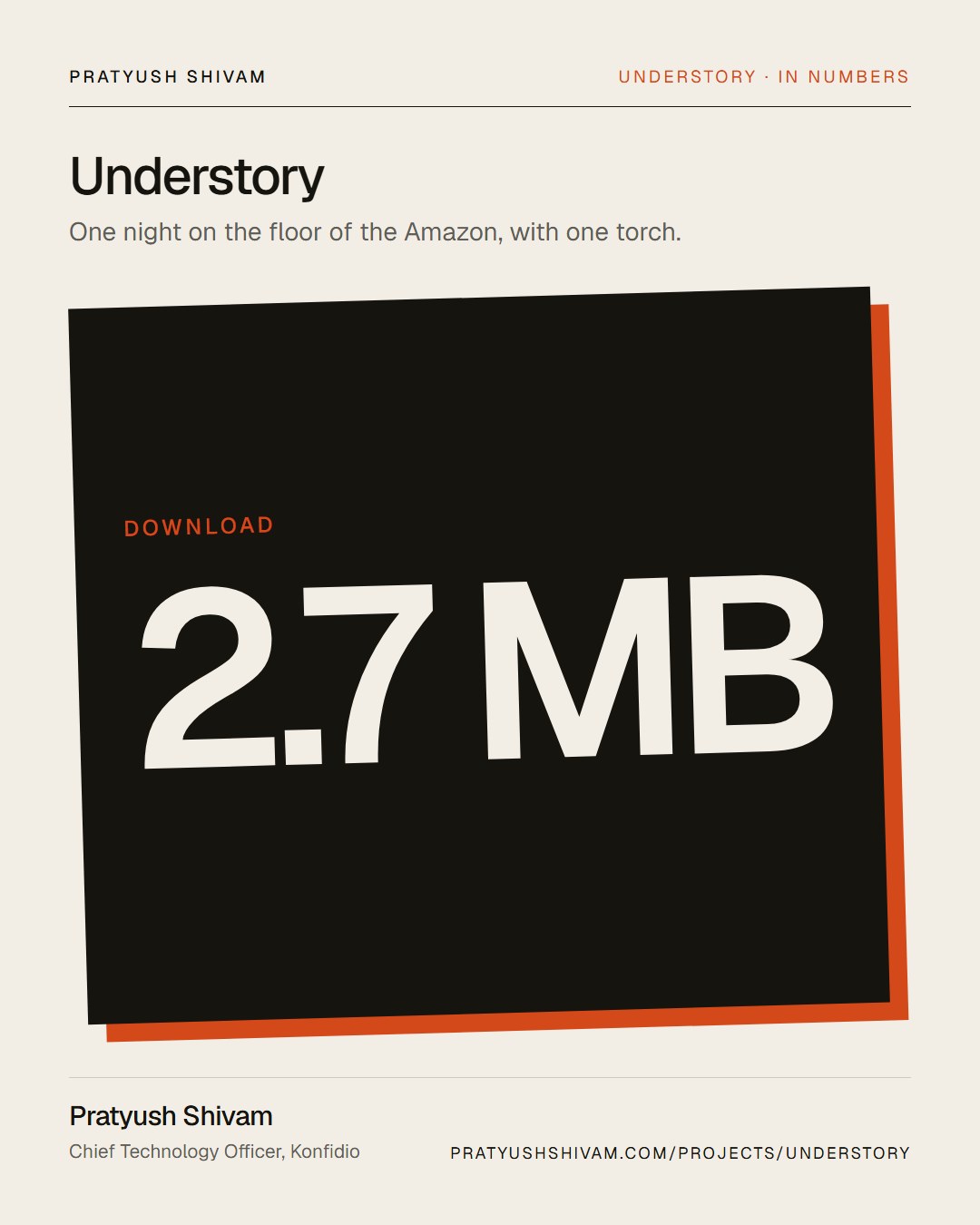
A film of Understory, a browser game by Pratyush Shivam: one night on the floor of the Amazon rainforest at Yasuní, Ecuador, with one torch, shot as real footage of the game. It shows a forest of 702 trees per hectare drawn with instancing, eyeshine from a black caiman across the river and an ocelot that fades with the fourth power of distance, animals placed at their real heights, the positions of animals with real field recordings played through an HRTF panner, and dawn light coming through the canopy. The whole game is 2.7 MB.
25 voices are field recordings shared on xeno-canto under Creative Commons licences. Some are the right species recorded elsewhere, such as the howler from Brazil. Insects, rain, thunder and the river are synthesised, and six animals are silent because no shareable recording was found.
02
Where is Understory set, and how much of the forest is real?
In terra firme forest at Tiputini Biodiversity Station in Yasuní, Ecuador. Tree density, palm share and heights follow published plots, and every animal has a record from the area. The ground plan is generated, and the animals are built from simple shapes at their true sizes.
03
How do I play Understory, and do I need headphones?
Walk with W A S D, look with the mouse and press F or click for the torch. On a phone the left thumb walks and the right thumb looks. Headphones and a dark room help, because each call is played from where its animal sits.