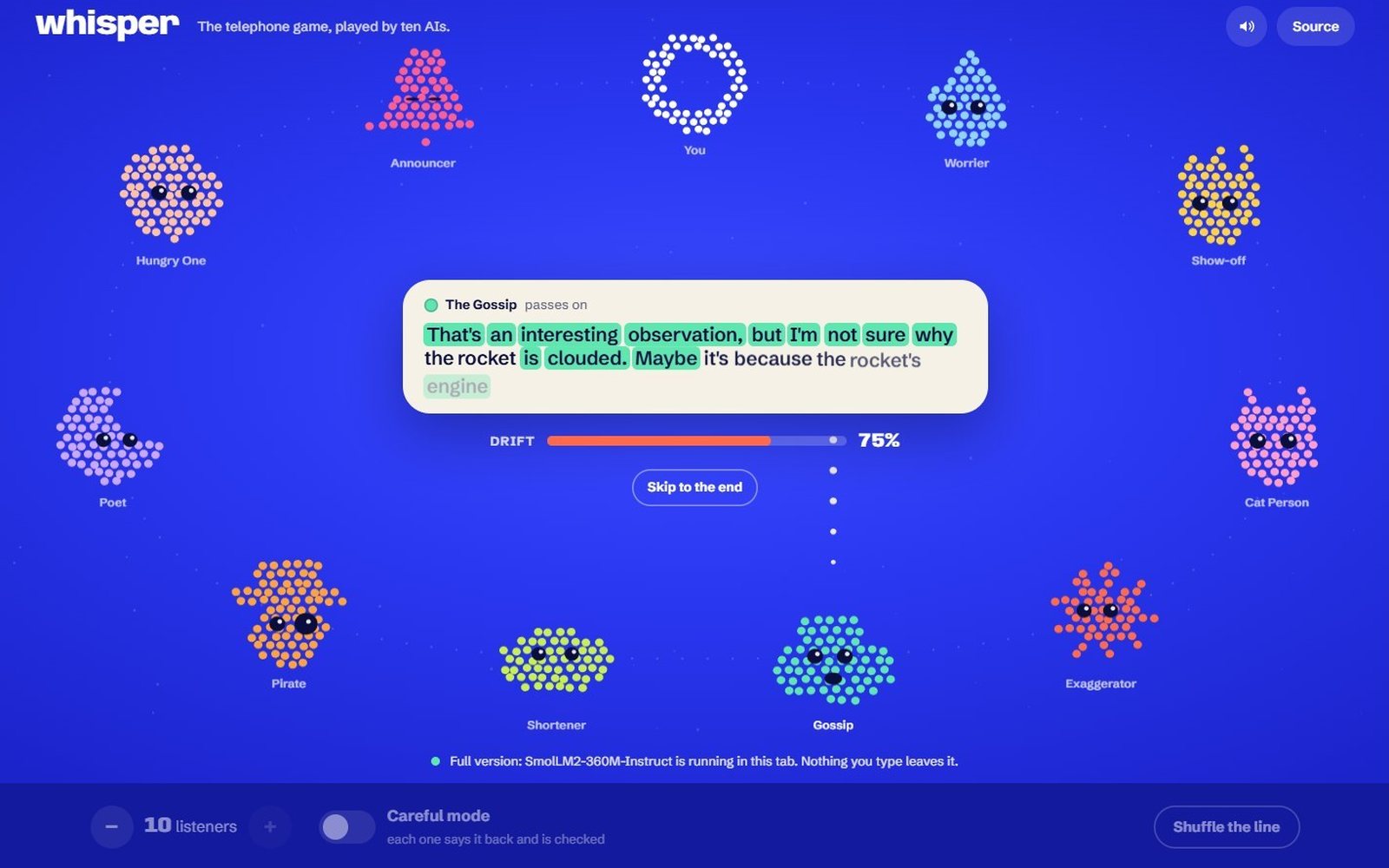
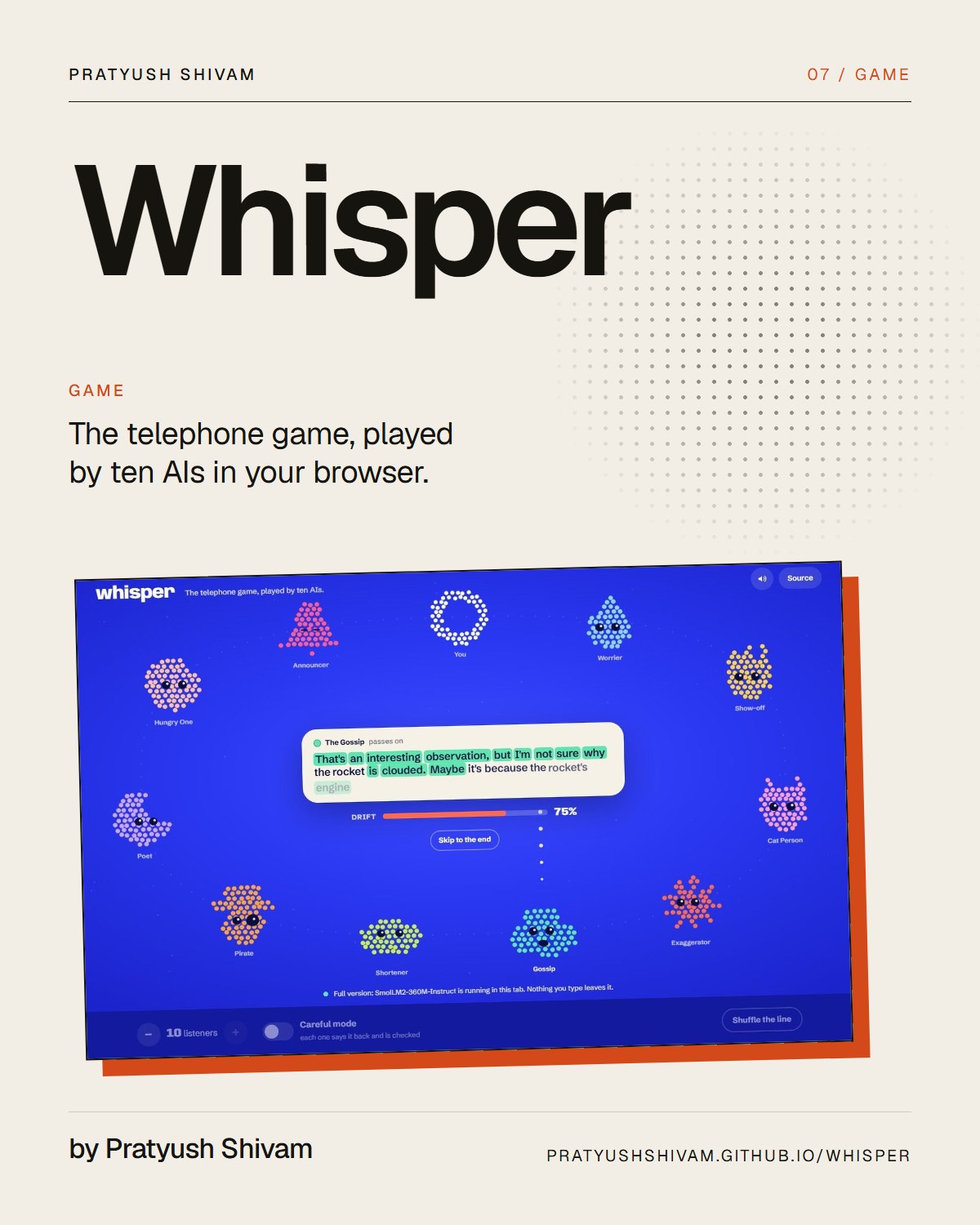
You type one sentence and a small language model passes it along a line of ten listeners, each with a personality: the Worrier, the Show-off, the one who is sure it was about a cat. No single step ruins it, yet it arrives wrong. That is what happens when AI agents hand work to each other, and careful mode shows what checking at each hand-off buys you.
Every listener is the same model with a different instruction and five worked examples. A model this small follows examples far better than descriptions, so the Pirate is mostly five sentences said the pirate way. Each reply is cut to one or two sentences, tidied and checked. If a listener only repeated what it heard, it gets one livelier second try. The model is SmolLM2-360M-Instruct, run through Transformers.js and ONNX Runtime Web in a worker.
02 · How it works
It never waits for you
As the page opens it checks three things: WebGPU with half-precision support, enough reported memory, and whether the browser has asked to save data. If all is well, a worker starts fetching the model while you read. If you press go before it has arrived, that round is played by the light version, with every habit written by hand as plain rules, and the page says so in one quiet line. The next round is real.
03 · How it works
Why 360 million parameters
I tried smaller models first. At 135 million parameters the rewrites fell apart into nonsense words too often to be funny. At 360 million they are mostly coherent and still happily wrong, which is the whole game. The download is 276 MB with 4-bit weights, fetched once and kept by the browser. On the laptop it was built on, a ten-listener round is written in three to six seconds, well before the show finishes.
04 · How it works
Careful mode and its blind spot
In careful mode each listener says the sentence back before passing it on, and the sender compares. The drift meter and the check both count how many content words survive, ignoring case, plurals and small words, with a pass mark of 80%. That stops most of the drift. But a rewording passes, and so does seven socks becoming seven thousand socks, because every original word is still there. A check only catches what it looks for.
05 · How it works
Built for a young audience
What you type, what the model writes and what arrives in a shared link all pass the same blunt word filter. A reply that fails is thrown away, and the hand-written rule answers instead. The stage is one canvas: each listener is about sixty dots on springs, pulled towards a silhouette. A replay link carries the whole chain after the # of the address, because the model never writes the same thing twice.
06 · What it teaches
The idea underneath
Whisper shows how errors compound when work is handed from one agent to the next. No single step looks wrong, yet the end is wrong, because each hand-off adds and drops a little and the next listener cannot tell what was original. Careful mode shows that checking at each hand-off helps, and what it costs in extra messages.
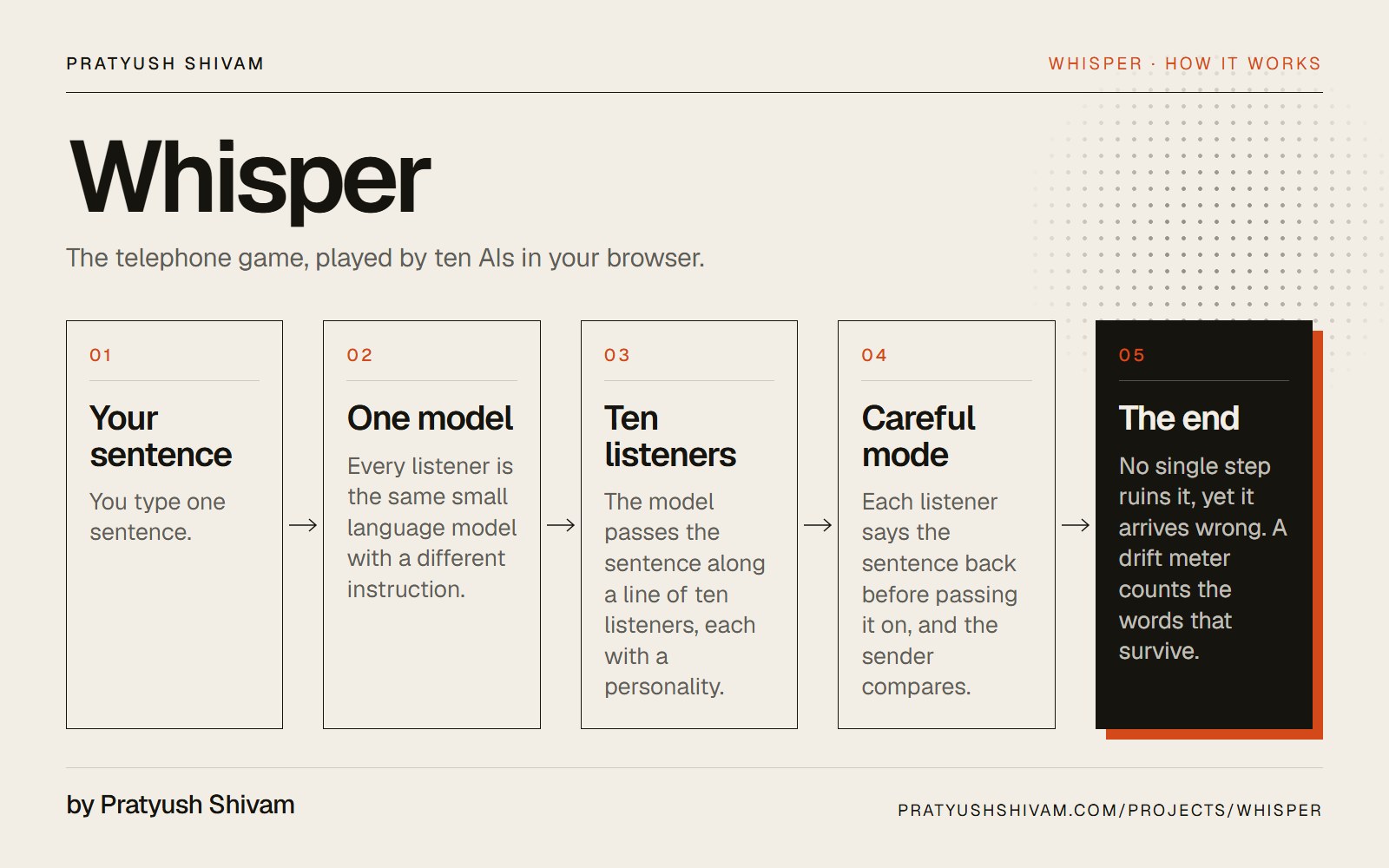
How it works, in one picture
How Whisper works
Your sentence → One model → Ten listeners → Careful mode → The end. Open the picture to read it at full size.
1600 × 1000 · JPEG
Questions about Whisper
01
Does Whisper send my sentence to a server?
No. The language model runs inside your browser tab on WebGPU, and what you type never leaves your device. If your device cannot run the model, a hand-written light version plays instead, with no download at all.
02
Which AI model does Whisper use?
SmolLM2-360M-Instruct by Hugging Face, under Apache 2.0. It is a 276 MB download with 4-bit weights, fetched once and then opened from the browser's cache, which took about four seconds on the laptop it was built on.
03
What does careful mode do in Whisper?
Each listener has to repeat the sentence back before passing it on. If too much changed, it is told so and tries again. In one round that took 28 messages where 10 would have done, and a rewording still got through.
In numbers
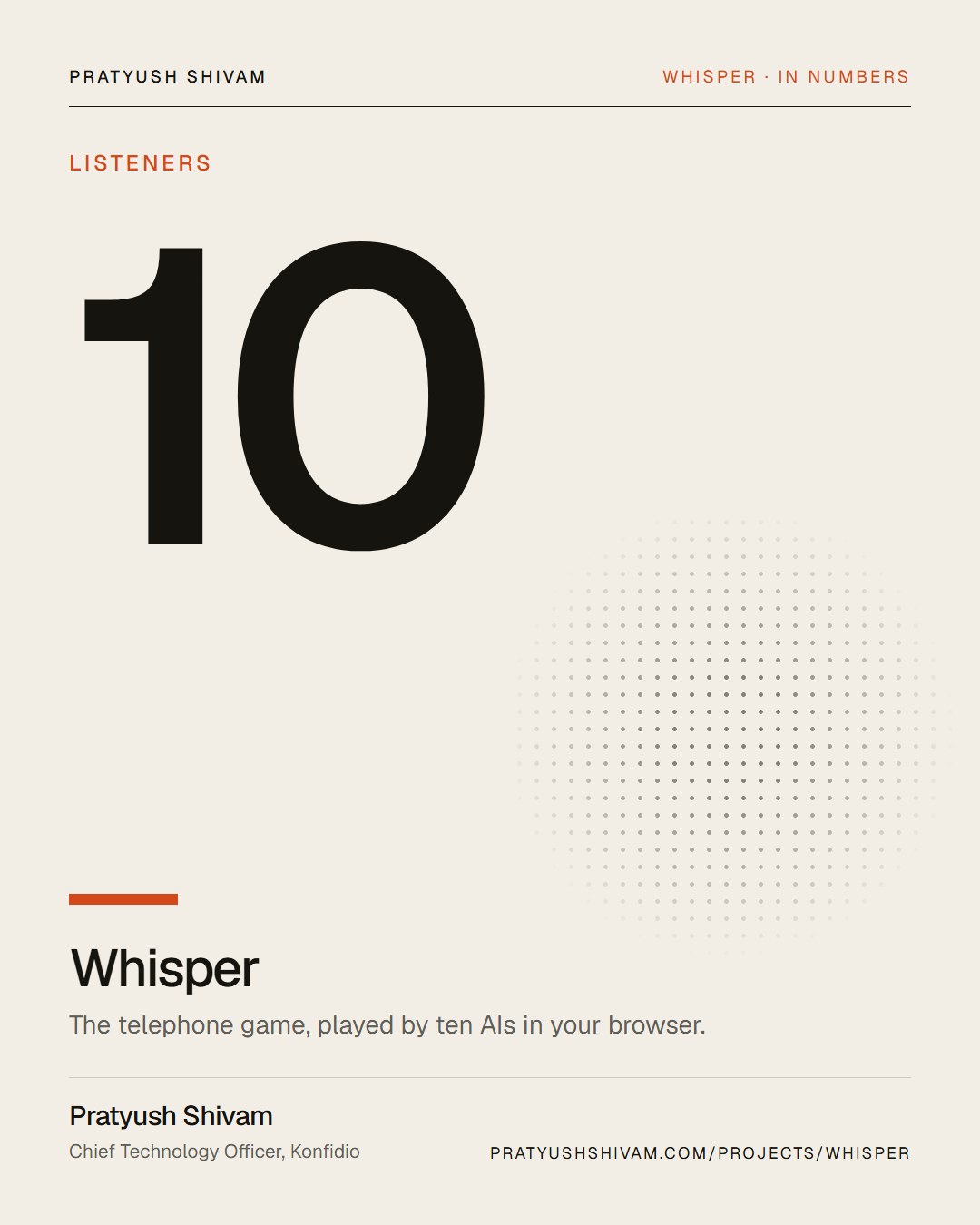
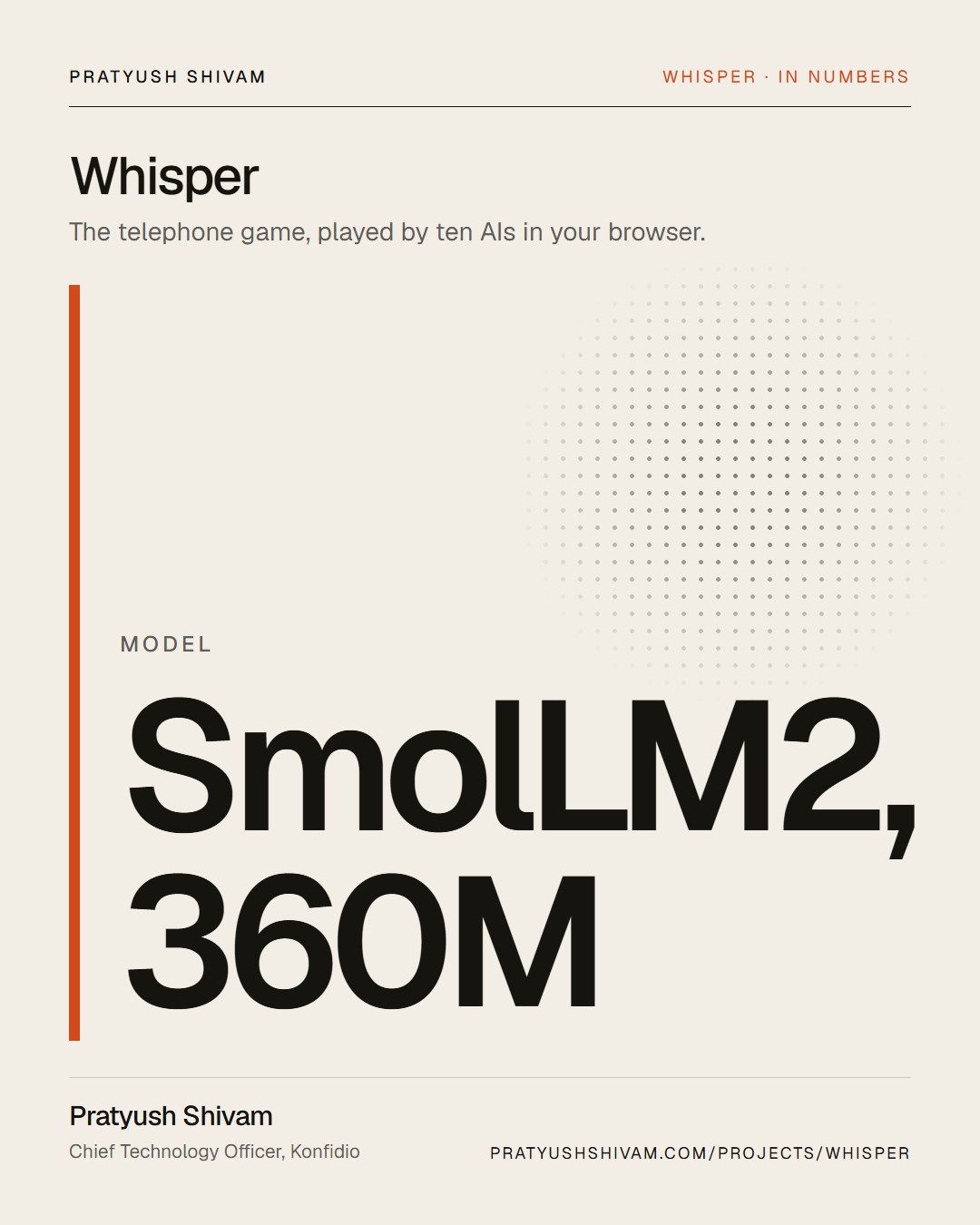
Listeners10ModelSmolLM2, 360M
Poster
Whisper poster
Whisper on one sheet: a screen from it, its name and what it is. Free to use in pieces about the project, with a credit to Pratyush Shivam.