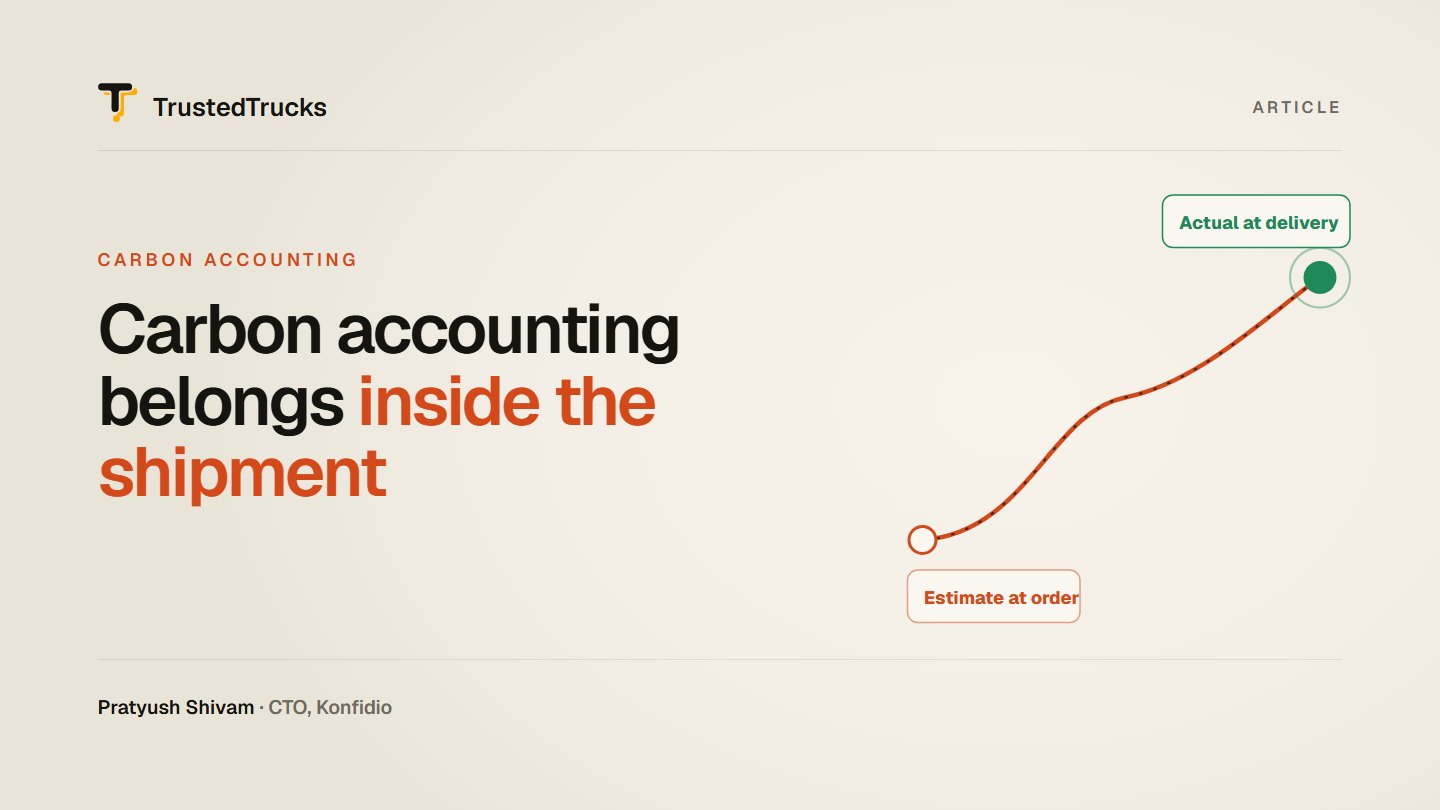
Most freight emissions reports are built backwards. A quarter ends, someone opens a spreadsheet, multiplies planned kilometres by a default emission factor and calls the result a footprint.
The truck, meanwhile, already knew what happened. It knew the distance it drove, the load it carried and the fuel it used. The information existed. It just never made it into the report.
Why estimates aren't enough anymore
For years, estimates were acceptable. Reporting was voluntary, and an average was better than nothing.
That is changing. The Corporate Sustainability Reporting Directive is pushing companies towards emissions figures they can defend. ISO 14083 and the GLEC Framework give logistics a common method for calculating and allocating transport emissions. Customers increasingly ask carriers and forwarders for shipment-level figures, not company averages.
When the question becomes "show me how you got this number", a spreadsheet of defaults is a weak answer.
The shipment already has the data
Here is the opportunity: almost everything a credible calculation needs is already part of the shipment.
- The planned route and load at the moment of booking.
- What actually happened on the road.
- The confirmed delivery, with its evidence.
If the emissions figure lives inside the shipment record, it can follow the same journey: an estimate when the order is placed, then an actual figure when the delivery is confirmed.
Estimate first, actual last
We think about carbon in two states, and keep them clearly separate:
- Estimated at order. Everyone plans with the same figure from the start, calculated on a recognised method.
- Actual at proof of delivery. Once the shipment is complete, the figure is recalculated from what really happened and attached to the same record as the delivery evidence.
Keeping both, clearly labelled, matters. Mixing estimates and actuals without saying which is which is how reports lose credibility.
Allocation is where it gets hard
A truck rarely carries one customer's goods. Groupage, multi-stop routes and return legs all raise the same question: how much of this journey's emissions belongs to each shipment?
Recognised frameworks answer this with allocation rules. The point of building them into the platform, rather than a spreadsheet, is consistency: the same rules applied the same way for every shipment, every time, with the inputs kept alongside the result.
Avoided emissions count too
Some of the best climate wins in freight aren't new technology. They are fewer empty kilometres. A truck that finds a load for its return leg instead of driving home empty avoids emissions that would otherwise have happened.
Measuring that properly, against a clear baseline and without double counting, turns efficiency into something a company can report and stand behind.
The bigger point
Carbon reporting, invoicing and proof of delivery have all suffered from the same problem: they are reconstructed after the fact from copies that don't agree. Put them in one shared record and they stop being separate projects. They become views of the same shipment.
I'm the CTO of Konfidio, where we build TrustedTrucks: one shared record for European freight.