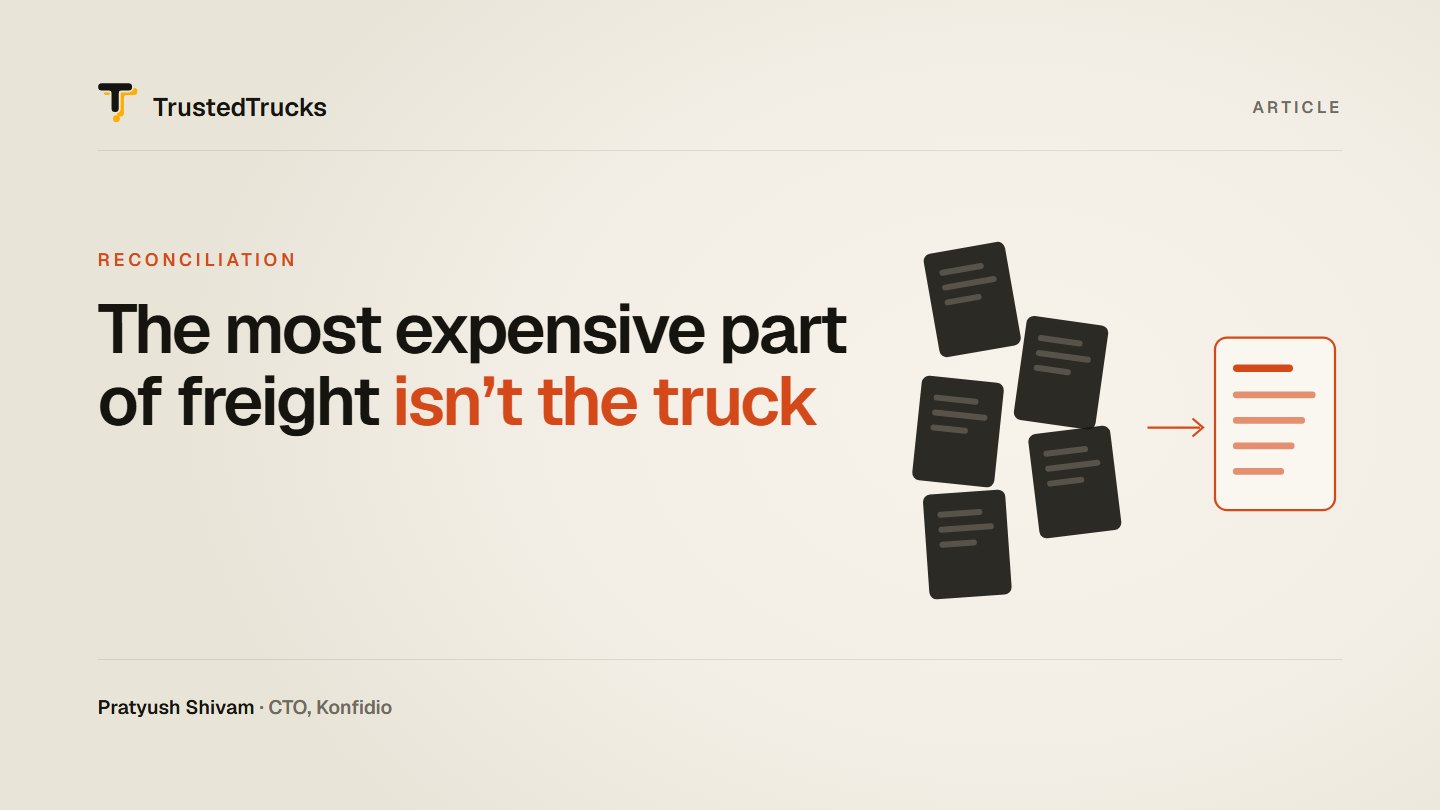
Ask people what freight costs and they'll talk about diesel, drivers, tolls and trucks. Those are real. But spend a week inside a forwarder's back office and you'll see a different cost, one that rarely shows up as its own line in any budget: reconciliation.
Five versions of one shipment
A single road shipment usually lives in at least five places:
- The request arrives by email.
- The agreement sits in a PDF or a portal.
- The journey is tracked in a telematics or tracking tool.
- The proof of delivery is a paper CMR, signed, scanned and sometimes lost.
- The invoice is typed again into an ERP.
Each copy is maintained by a different company, in a different system, with a different idea of what happened. They drift apart from the first minute.
Where the money actually goes
When those versions disagree, people step in. Someone re-keys data from a PDF. Someone chases a signature. Someone compares a delivery note with an order line by line. Someone disputes a waiting-time charge because the timestamps don't match.
None of this moves a single pallet. All of it delays payment.
For carriers, especially small ones, that delay is not an inconvenience. It is working capital tied up in paperwork. A truck that delivered on Monday is still unpaid weeks later because a document is missing or disputed.
Integrations don't fix it
The usual answer is integration: connect the TMS to the ERP, the ERP to the portal, the portal to the telematics provider. It helps, until it doesn't.
Every integration is its own project, its own data format and its own failure mode. And they multiply. Five companies connected one to one need ten links. Ten companies need forty-five. Each one breaks on its own schedule, usually silently, usually right before month end.
Integrations move copies around faster. They don't remove the copies.
One record instead of five
The model we've built at TrustedTrucks starts from a different question: what if there were only one record?
- The request, quotes and agreement stay attached to the shipment.
- Documents are uploaded once and seen by every party on it.
- Approvals follow each company's own signing route and are recorded against the shipment.
- Accepted delivery evidence becomes the basis of the invoice.
Reconciliation becomes verification. Instead of comparing five versions, every party checks the same one.
Why shared needs to mean trusted
Sharing a record between competitors and partners only works if nobody can quietly rewrite it. That is the part where a permissioned blockchain earns its place: it anchors the record so changes are visible, and it lets each party see only what its role allows.
The technology is the enabler, not the point. The point is a carrier who gets paid because the evidence is already there, and a finance team that stops chasing paper.
The question I'd ask any logistics team
Pick one shipment from last month and count how many systems it touched and how many times someone typed the same information. That number is your reconciliation cost. Most teams are surprised by it.
I'm the CTO of Konfidio, where we build TrustedTrucks: one shared record for European freight.